Southwards and waiting for fair winds
In the Turku archipelago, we had reached the northeastern turning point of our journey. The Finnish bays bordered by deep emerald forest were empty; almost all sailboats had already turned south. The long days were getting shorter.
We had chosen Rödhamn as our point of departure to cross from the Åland islands to Sweden. But reaching it took a day of hardship: hours of motoring against the wind, a lost drone, a route with no buoyed fairway through skerries south of Föglö. When we finally moored, there was no electricity for our espresso machine, and our fridge was looking empty – not appealing with days of waiting for fair wind ahead of us during stubborn southwesterlies.
The drone had thrown itself into the sea with a headfirst dive directly from the cockpit. We launched Henry, as we had named it, in the usual way. Somehow it must have lost the courage to fly over the skerries in this vast seascape. Perhaps a front rotor simply failed. But it looked like a verdict on the view. The sublime can only be enjoyed from a place of safety, and Henry never felt safe flying from a sailboat.
The forecast on the bread bag
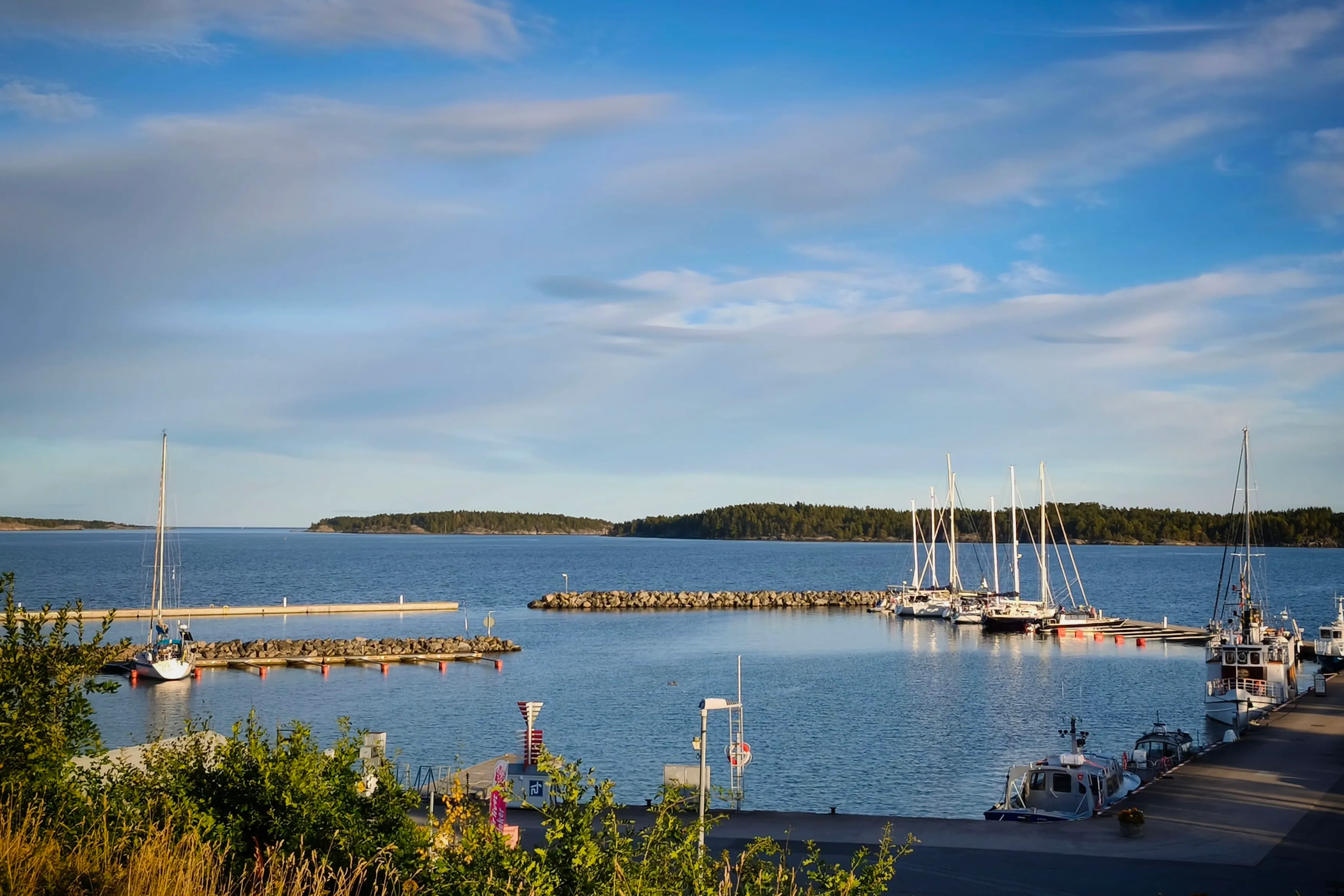
Rödhamn was a quiet natural harbour that protected us from every direction – a base for the Swedish and Russian navies for centuries. Freshly baked bread was delivered to the bow of the boat first thing in the morning with the wind forecast written on the bag. The café served delicious cinnamon rolls. And there was a sauna with a wooden bench to sit on after a jump into the refreshingly cold water, only a few steps away.
We waited four pleasant days in Rödhamn for the wind to turn. The couple who have been running the guest harbour for thirty years lovingly care for every detail, from the wooden jetty fitted along the rounded rocks, to the café serving lunch, to the facilities, and to an exhibition of watercolour paintings by Anette. Her advice was to never lose the joy of painting.
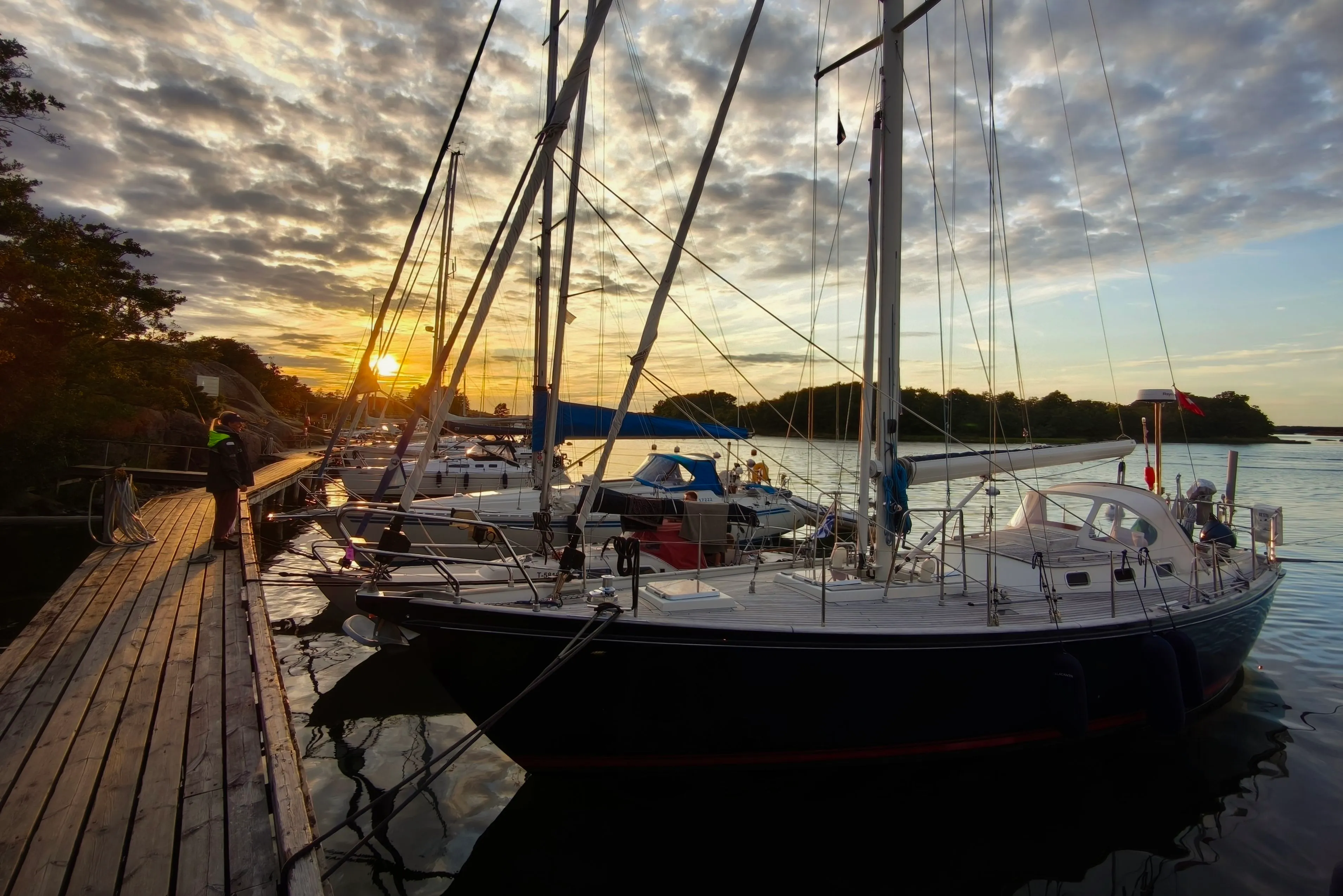
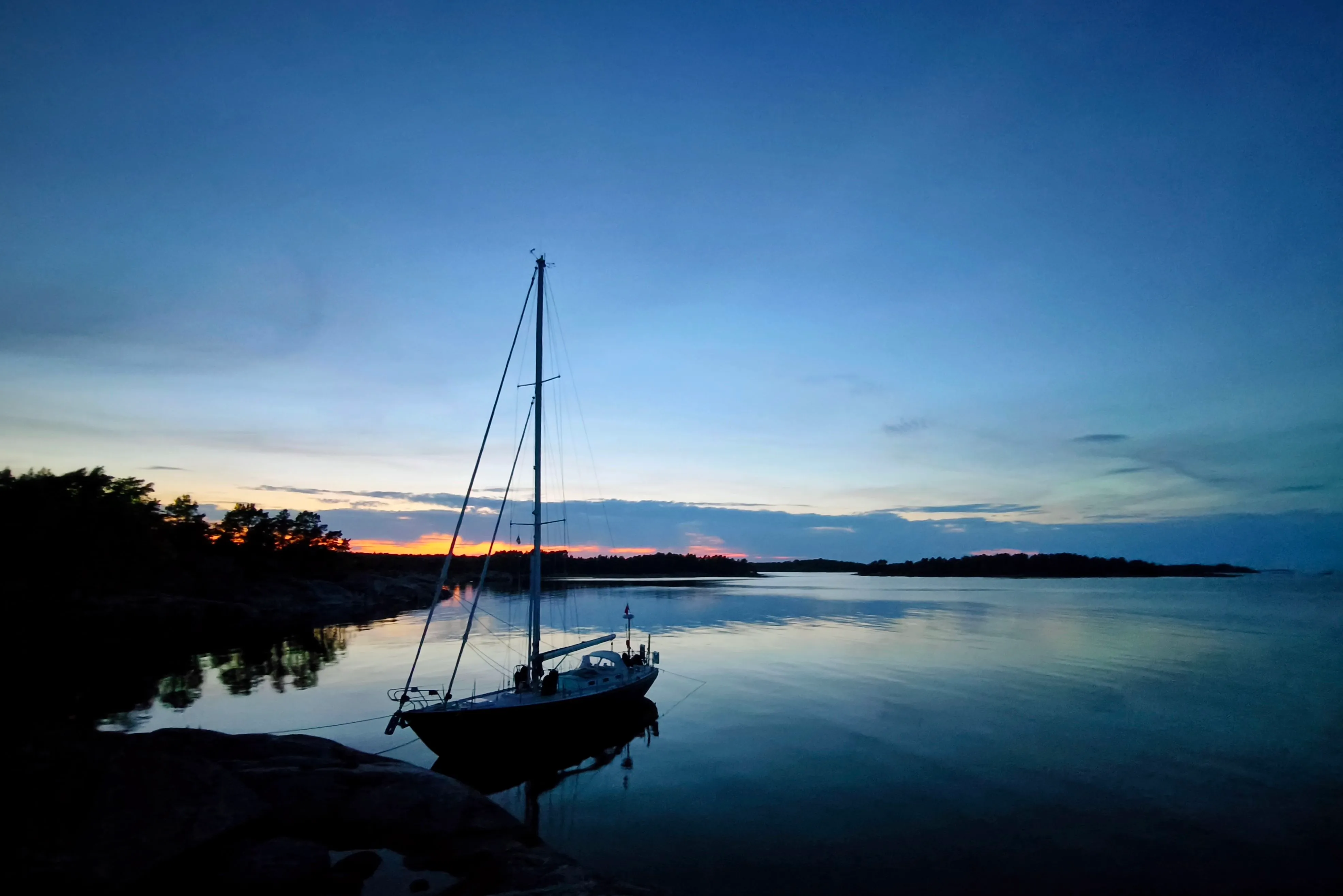
Moored in Rödhamn, Åland.
Then came a low-pressure system moving across the Gulf of Bothnia, some hundred miles to the north of us, that would bring a northwesterly wind. The barometer fell from 1015 to 999 hPa in 24 hours, a drop Ilma lists next to the Navtex warnings. After getting up at four o’clock, we cast off in a stiff crosswind that pushed Coelacanth to port, the prop-walk side that always makes the helmsman sweat.
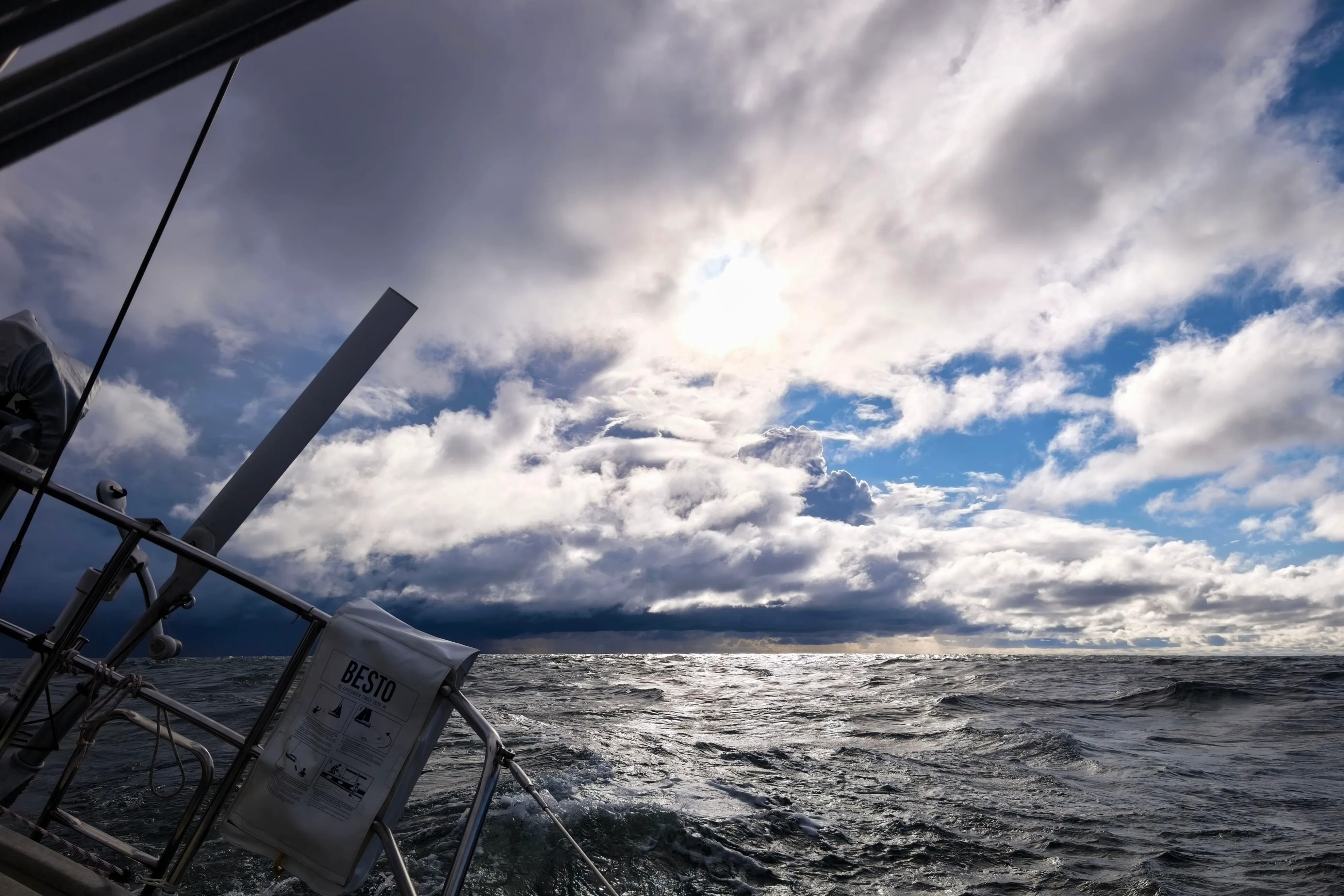
The sky was clear and the wind already strong. After we had set the mainsail, a dark wall of towering clouds appeared in the west – the cold front. We managed to avoid the heaviest of the showers that fell like a grey curtain to the horizon. Our depth sounder blinked a last time showing 180 metres, then only three dashes. Here, the Åland Sea holds among the deepest water in the Baltic, and it’s astonishing how steep the sea floor falls off.
Four hours or 28 nautical miles after departure, we reached Remmargrund lighthouse, marking the entrance to the northern Stockholm archipelago. That had already been swift sailing. But now the skerries prevented any waves and made the water almost flat. Coelacanth accelerated to over eight knots. We raced through the skärgård and reached the entrance to Nynäshamn in the evening, a hundred miles since Rödhamn.
Instead of mooring in Nynäshamn’s marina, we turned south and passed Skrapan lighthouse in the encroaching darkness. A pilot vessel sped to a freighter heading out, but thereafter, no other ship stirred the water. For an hour, the sea was flat calm, mirroring a pale red glow in the west. Far away, the Gustav Dalén lighthouse sent its double flash into the night – named for the inventor of its light, blinded by his own experiments. Ursa Major, which Homer says alone never bathes in the Ocean, circled in the north, watching Orion. Odysseus kept it on his left hand when he left Calypso’s island and steered for home. We had it on the starboard quarter, the north falling astern. Sky and sea coalesced.
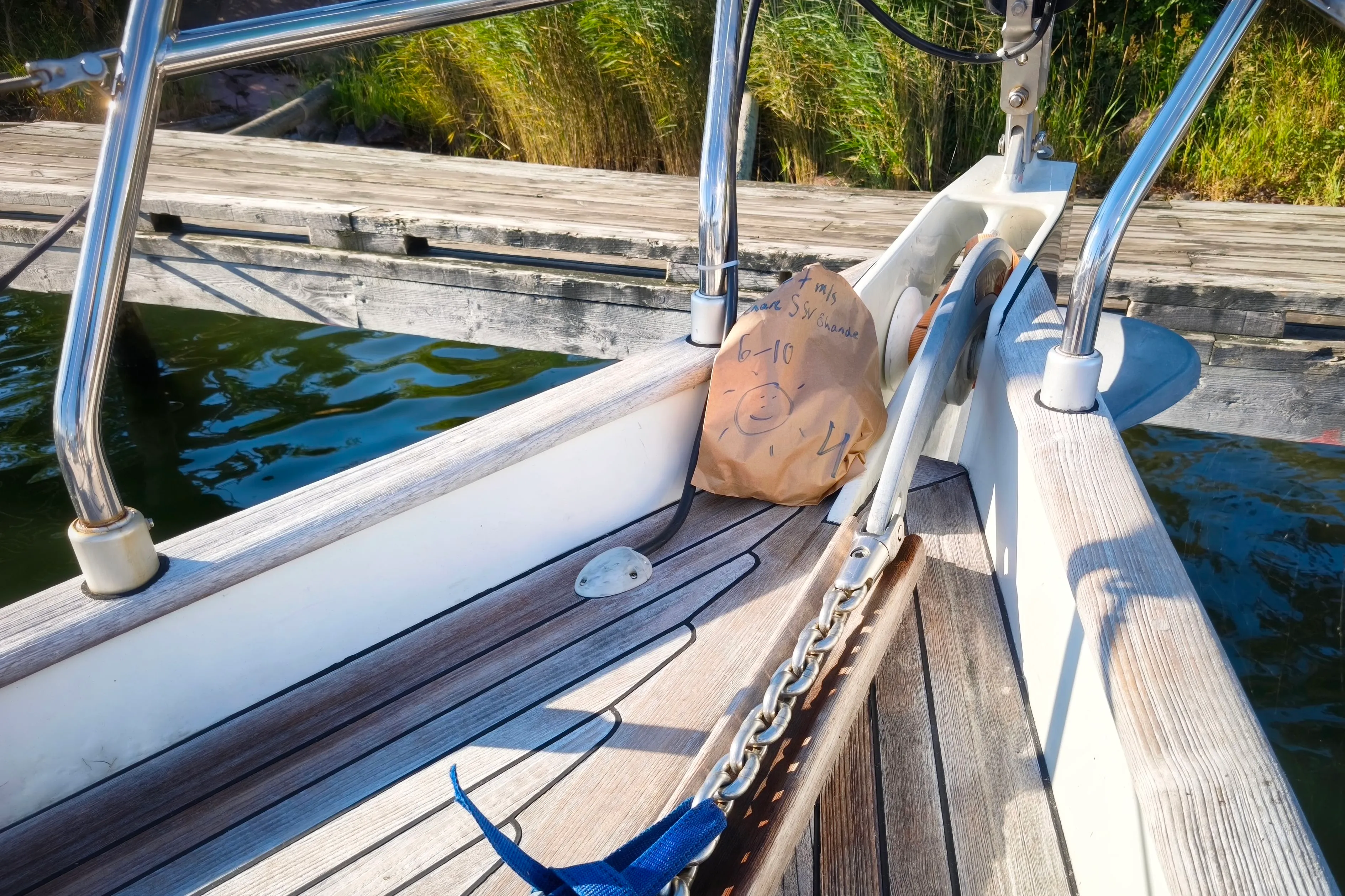
Fresh bread is delivered to the bow of the boat first thing in the morning. Weather forecasts are written on the bag. Rödhamn, Åland islands.
Stängt för säsongen
The sun rose behind Coelacanth’s stern and soon the first of the flat outer skerries appeared. At Sandsänka, we entered the skärgård again, only a few miles south of Kupaklint, where we had anchored a month ago when sailing northwards.
Well before noon, we entered the almost empty guest harbour of Fyrudden. We had sailed 154 nautical miles in thirty hours: a lively crossing of the Åland Sea meeting a cold front, then all the way through Stockholm’s archipelago, passing Nynäshamn, and entering the skärgård again.
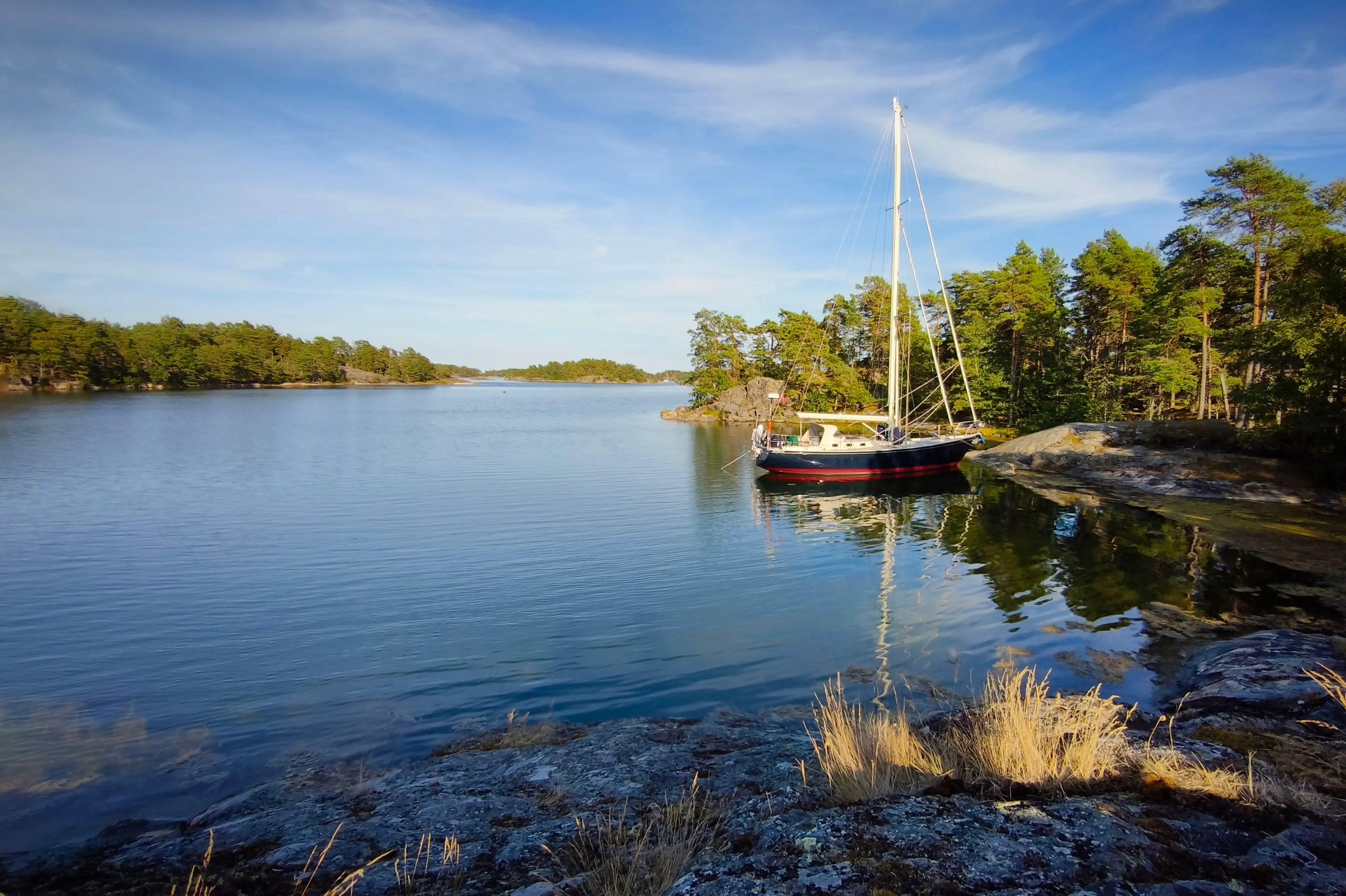
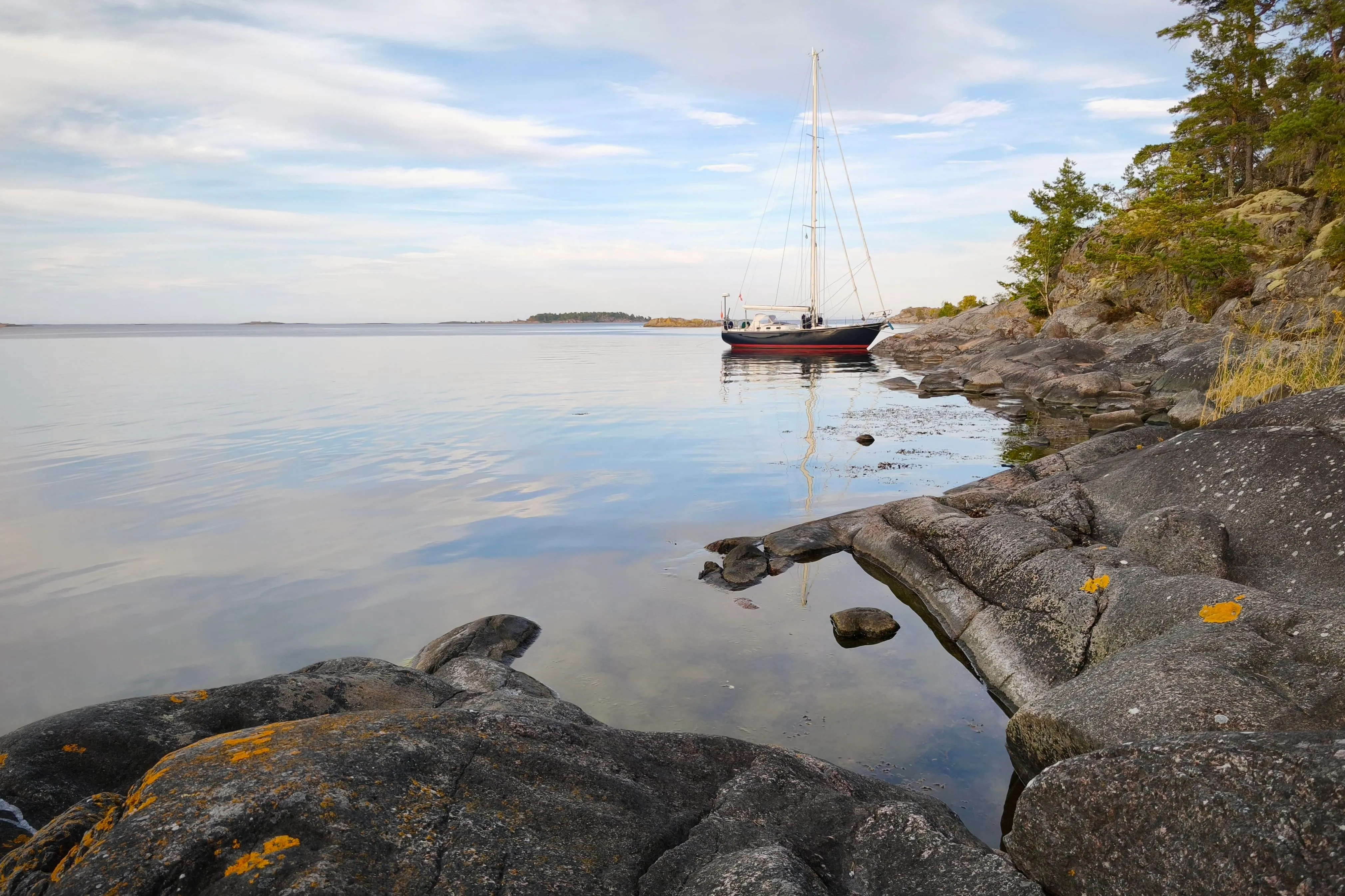
The end-of-season atmosphere was tangible; stängt för säsongen signs were getting more frequent. However, the shop in Fyrudden was open and we were finally able to refill the fridge. After a long and dreamless sleep, we made use of the westerly wind and sailed to the bay between Långö and Trässö to the west of Jungfrusund. Here, dozens of spots invite you to anchor or moor at the rocks with protection from almost all directions.
The fairway south led along the open sea where the water is clear. The beauty of this part of the coast impressed us the following night in Stora Förö. We sat in the cockpit watching the light fade – aware that this was the last night anchoring in the skärgård.
Every sail in the locker
The entrance to Figeholm led us through a slalom course around hidden rocks. The harbour is cosy and tempts you to stay several days. On the Ovni moored on portside, the skipper dozed in the cockpit; apparently, he had arrived after a long leg overnight.
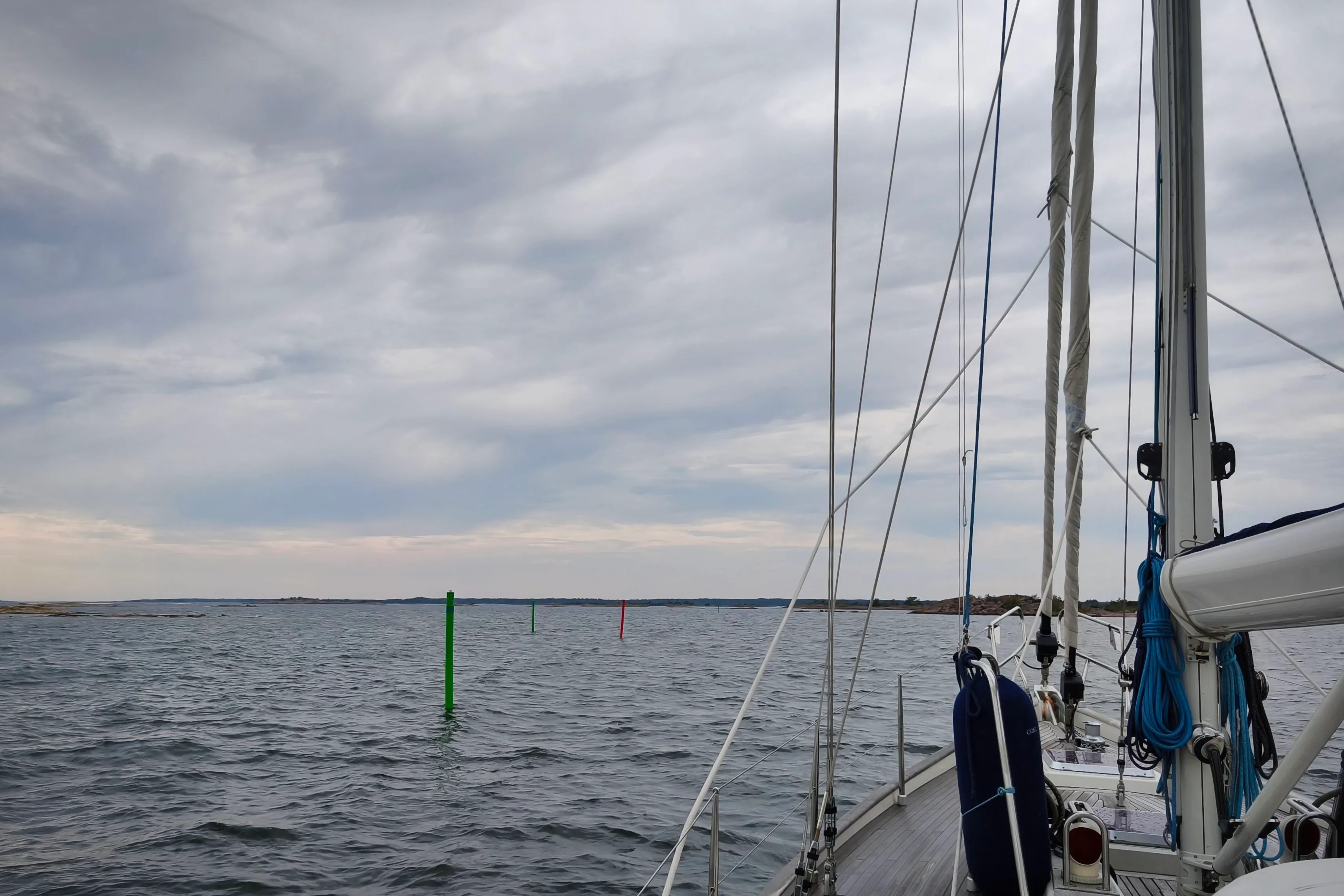
We left early and sailed southwards, passing Kalmar, out of which we had tacked north against a week of northerlies. A day of fast sailing – 58 miles from Figeholm to Ekenäs – raised our spirits. It was bracketed by two days of motoring against the southerly wind. Before reluctantly starting the engine, we had tried every sail in the locker: the huge gennaker, new this spring, after departure when there was only a faint breeze, the Klüver for a close reach, and the jib for tacking when the wind turned. Finally, it was the mainsail alone and then no sail at all while motoring into the wind.
We moored in Ekenäs, one of the small guest harbours operated by a sailing club. We had been lured in by the description of a small bakery selling much-praised bread and cinnamon rolls. Disappointment was palpable when we stood in front of closed doors.
In Ekenäs, a sailboat lay at the pump-out station where the holding tank can be emptied. These stations are common, as it’s illegal to discharge sewage in Scandinavian waters. After several hours the boat still had not moved. In the evening, an elderly couple produced a fishing net and carefully placed it in the water around the pontoon. When we were casting off in the morning, I saw the woman hauling in the net with half a dozen twitching fish of a good kilo each. That’s a lot of fish to eat for two people. I hope the pump-out station did not spoil their appetite.
The other Sandhamn
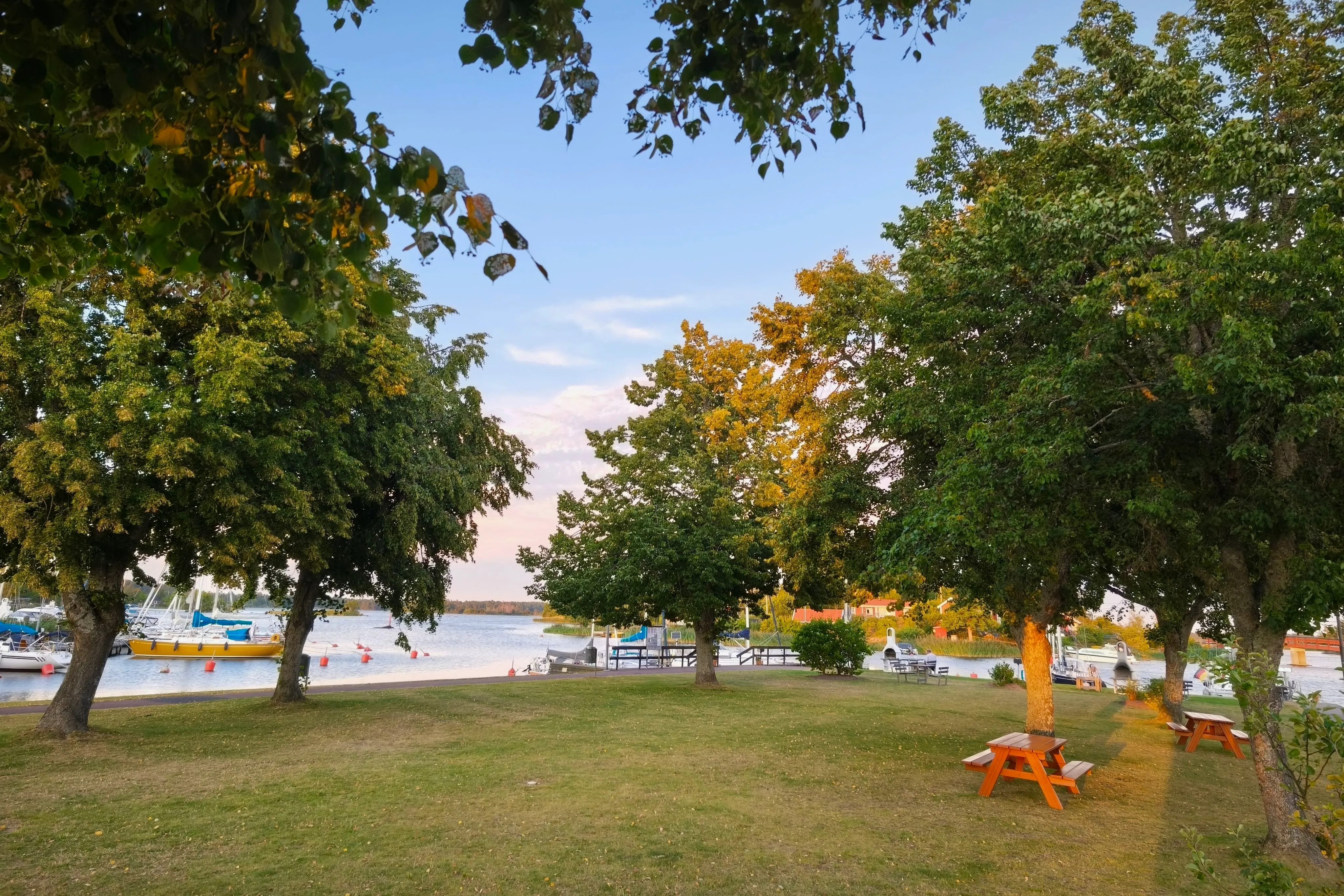
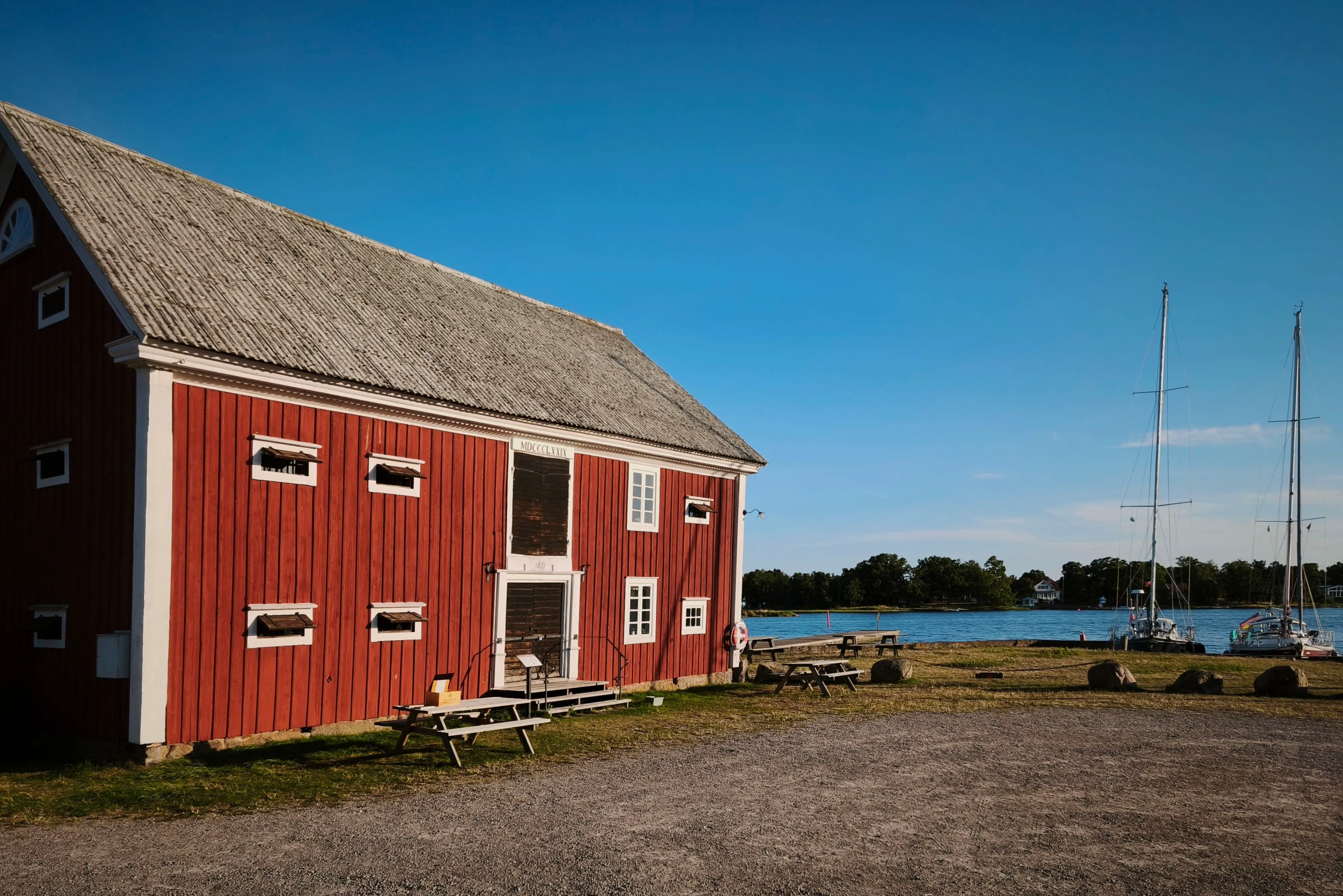
Sandhamn is a famous name in Sweden’s yacht club scene – comparable to Cowes in England. We had not visited the popular summer holiday spot; the Sandhamn we chose for a day of rest was not the one in Stockholm’s archipelago, but situated at the eastern edge of Hanö Bight. Here, yachts stop on the way south, motorhomes spend a day on a dusty lot – and it is quiet with the clearest water seen so far. And the coldest: 13°C was really cold for our swim. And there was no sauna!
We were tired of motoring. Every hour under engine feels like a defeat for a sailor. So we took a rest day. It was the first time we had spent more than one night in the same place after a week of sailing southwards, 305 miles since Rödhamn.
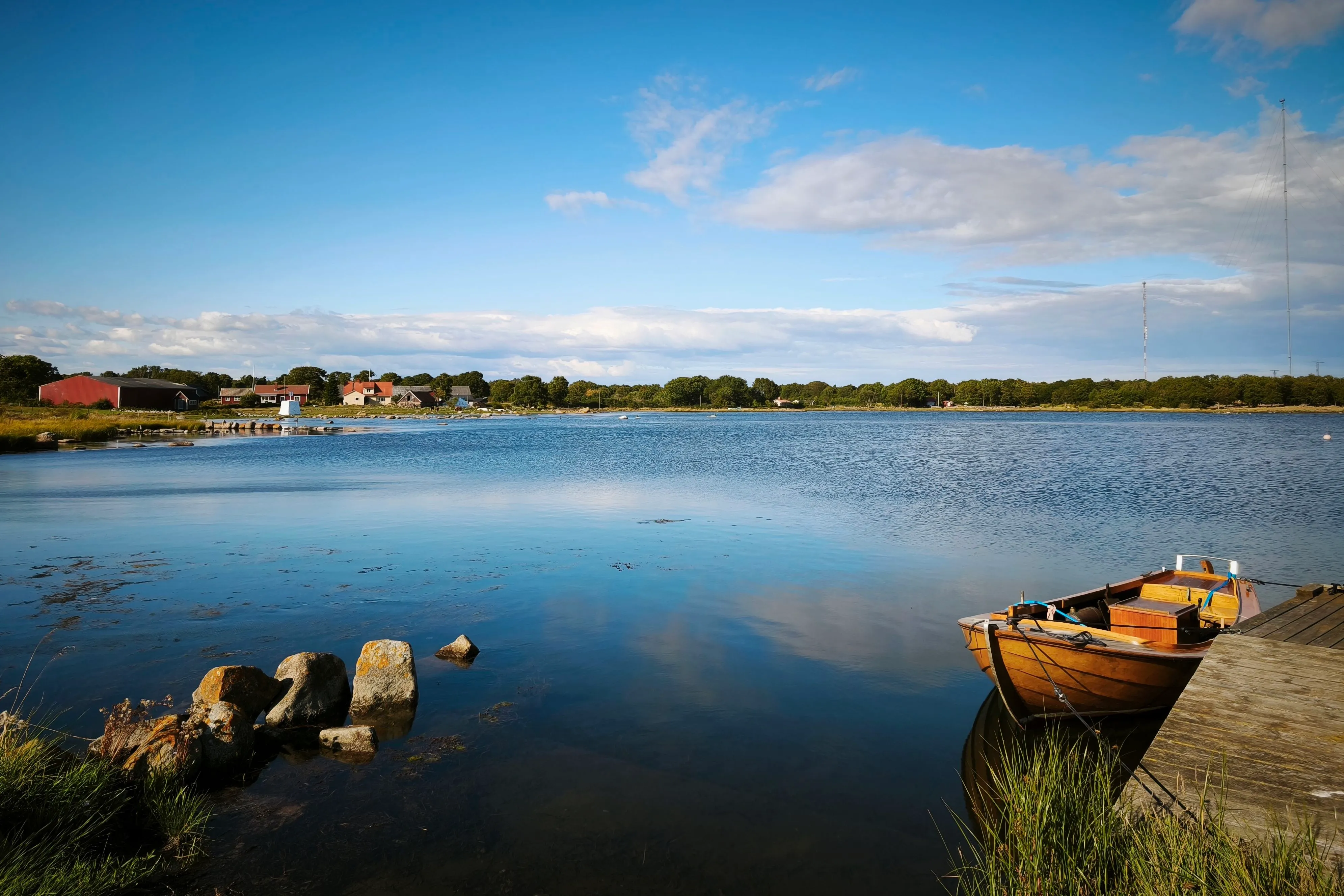
Sandhamn at the eastern edge of Hanö Bight.
The wind serves no master
A week of southwesterly wind was predicted – not at all a fair wind for crossing the Hanö Bight. The days of serial low-pressure systems brought grey clouds, rain, and the air of autumn. Instead of a direct course – as our eastbound Hanö bight crossing in Beaufort 6 to 7 with spray flying and a second reef in – we decided to tack our way along the coast with stops in Ronneby, Nogersund, and Skillinge. And we were glad to have found these small harbours in the Hanö Bight; they were friendly and quiet. Nogersund has the atmosphere of a centuries-old fisher harbour. And in Skillinge, we watched the club of seniors swimming in the sea every morning despite water temperature dropping by a degree each day. Finally, we had to catch up and jump in ourselves.
A week of coastal hops later we lay in Ystad, where a high-pressure system from the North Sea was strengthening over Scandinavia, bringing easterly winds – fair winds for sailing towards Denmark and Germany.