Gennaker Sailing

Today, we sailed with our new gennaker for the first time. Conditions couldn’t have been better: sunshine, first Beaufort 3, later a phase with no wind at all, then picking up again.
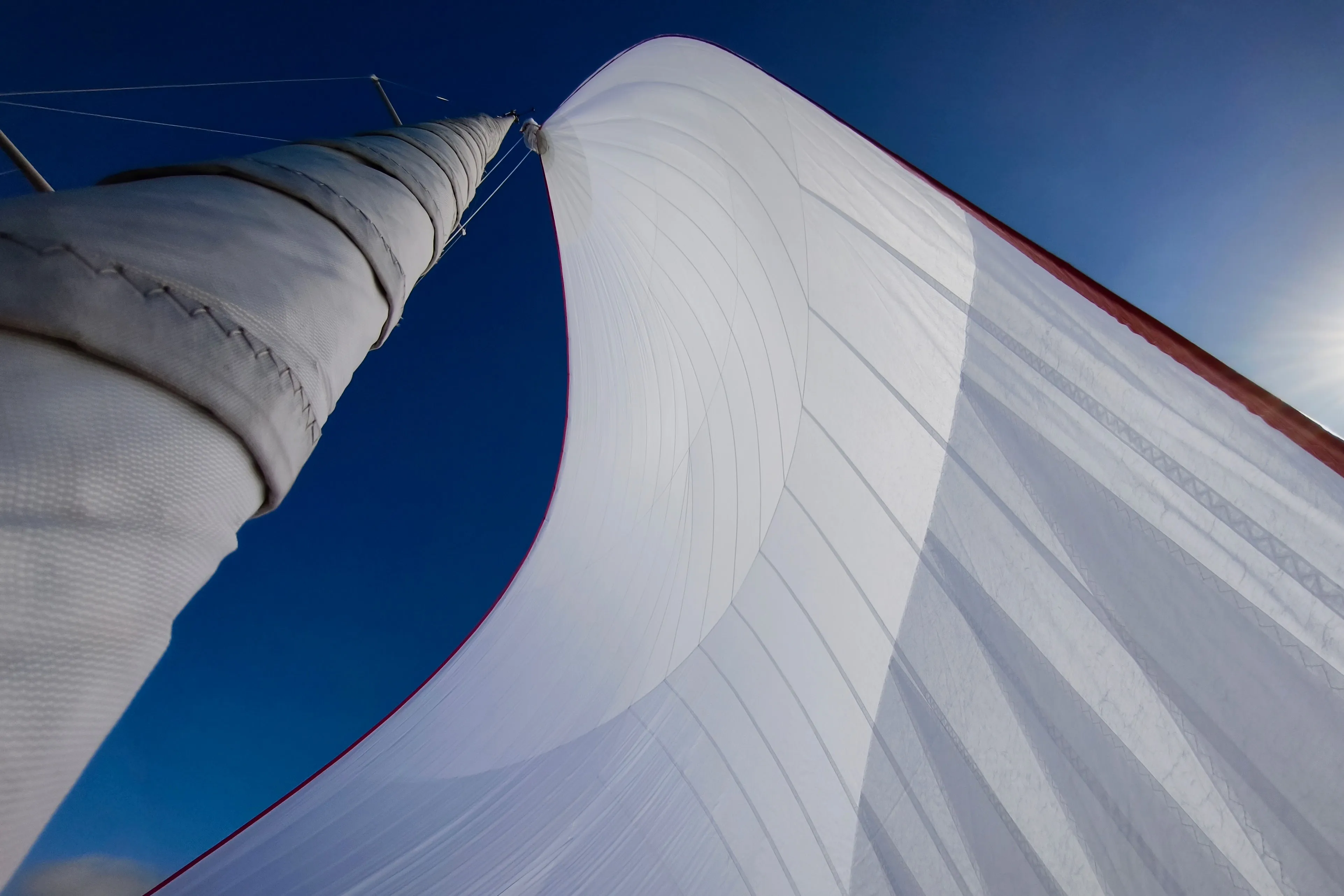
Sailing with the new gennaker.
Our gennaker is bigger than all our other sails together: 118 m2. Hoisting and lowering with the sock is easy. Using a variable line at the bowsprit to tighten (for close reaching) and ease (for sailing downwind) the tack makes it even smoother.
Courses from 80-160° apparent wind are possible. The performance win is more than we dared to hope. At light winds, courses deeper than 120° were usually slow – Coelacanth is a full-keeler made for heavy weather. The yankee sail collapses in light winds and starts to flap. Not so the light gennaker made from 64 g/m2 light cloth. Specifically, we were still doing 2.4 kts at 5 knots true wind speed (Beaufort 2) at an apparent wind angle of 160°. At Beaufort 4 and 150° AWA, we were doing between 6.5 and 7.2 knots. The gennaker adds about 1.5 to 2 knots of speed.
Usually, all the light fibreglass boats sail away in a faint breeze. But today, we were overtaking them all.
How much energy is that?
A gennaker of 118 m2 is a lot of cloth. I wondered how much work it actually does. With 10 knots of true wind (Beaufort 3) and Coelacanth moving at 4 knots on a broad reach, the apparent wind on the sail sits around 8 knots. The standard formula for aerodynamic force on a sail puts the total at roughly 1400 newtons.1 This converts to about 140 kg spread across the halyard, the tack line at the bowsprit, and the sheet at the clew. Only a part of that pushes the boat forward, perhaps 1000 newtons.2
Force times distance gives work. Over one nautical mile, the gennaker does close to 2 megajoules of work on the hull.3 Over an hour at 4 knots, that adds up to about 7 megajoules. Expressed as power, this is 2 kilowatts, just under 3 horsepower to keep moving. In silence, without fumes.
Our diesel engine, doing the same job, would loaf along at a small fraction of its rating (63 hp, or 47 kW) and burn roughly 1.5 litre of diesel per hour. This produces about 4 kg CO2,4 the amount a mature tree can absorb in about two to three months.5 The remaining power is there for the moments we need them: manoeuvring in and out of a harbour, a foul current – or a breeze too faint to sail.
We humans currently emit nearly twice the amount of CO2 that the Earth can maximally absorb in oceans and plants.6 To actually stop atmospheric CO2 from rising further, emissions need to fall to zero.
The new gennaker lets us sail in light wind instead of motoring.
Footnotes
- F = ½ρV²AC, where ρ is air density (about 1.225 kg/m³), V is apparent wind speed in m/s, A is sail area in m², and C is the dimensionless total force coefficient. For an asymmetric spinnaker on a broad reach, C lies in the range 1.1 to 1.4. With V = 4.1 m/s (8 knots), A = 118 m², and C ≈ 1.15, F ≈ 1400 N. Marchaj CA. Aero-Hydrodynamics of Sailing. 3rd ed. Adlard Coles, London 2000.
- The total aerodynamic force splits into a driving component along the boat’s heading and a side component perpendicular to it. The ratio depends on apparent wind angle and the sail’s lift-to-drag ratio. On a broad reach the driving fraction for an asymmetric spinnaker is roughly 0.5 to 0.7.
- Work = force × distance. One nautical mile is 1852 m. At 1000 N driving force, W ≈ 1.85 MJ per nautical mile. Over an hour at 4 knots, W ≈ 7.4 MJ, an average power of about 2 kW.
- Marine diesel emits about 2.68 kg CO2 per litre fully combusted. IPCC 2006 Guidelines for National Greenhouse Gas Inventories. Volume 2: Energy, Chapter 3: Mobile Combustion.
- A mature tree sequesters roughly 20 to 25 kg CO2 per year, depending on species, size, and climate. McPherson EG, Simpson JR. Carbon dioxide reduction through urban forestry: guidelines for professional and volunteer tree planters. USDA Forest Service General Technical Report PSW-GTR-171, 1999.
- Global anthropogenic CO2 emissions reached about 37 Gt in 2023. Land and ocean sinks together absorb roughly half; the remainder accumulates in the atmosphere. Friedlingstein P et al. Global Carbon Budget 2023. Earth System Science Data 2023;15:5301-5369.