A Coelacanth in Stockholm
The near-gale had passed after 36 hours of howling and slamming. The barometer had risen again, the air was clear, the wind still strong. Lines were cast off. Sailing close-hauled out of Nynäshamn, along the fairway through Mysingen and past Rånö, Utö, and Ornö, I counted 18 tacks against the northerly wind.
The entry into Kymmendö’s anchorage passes close under narrow granite cliffs. Kymmendö was Strindberg’s inspiration for The People of Hemsö. In the opening of the novel, Carlsson’s clumsy sail manoeuvres are ridiculed by pilots standing on the customs bridge. I was relieved that my anchor manoeuvre went well even if nobody was watching.
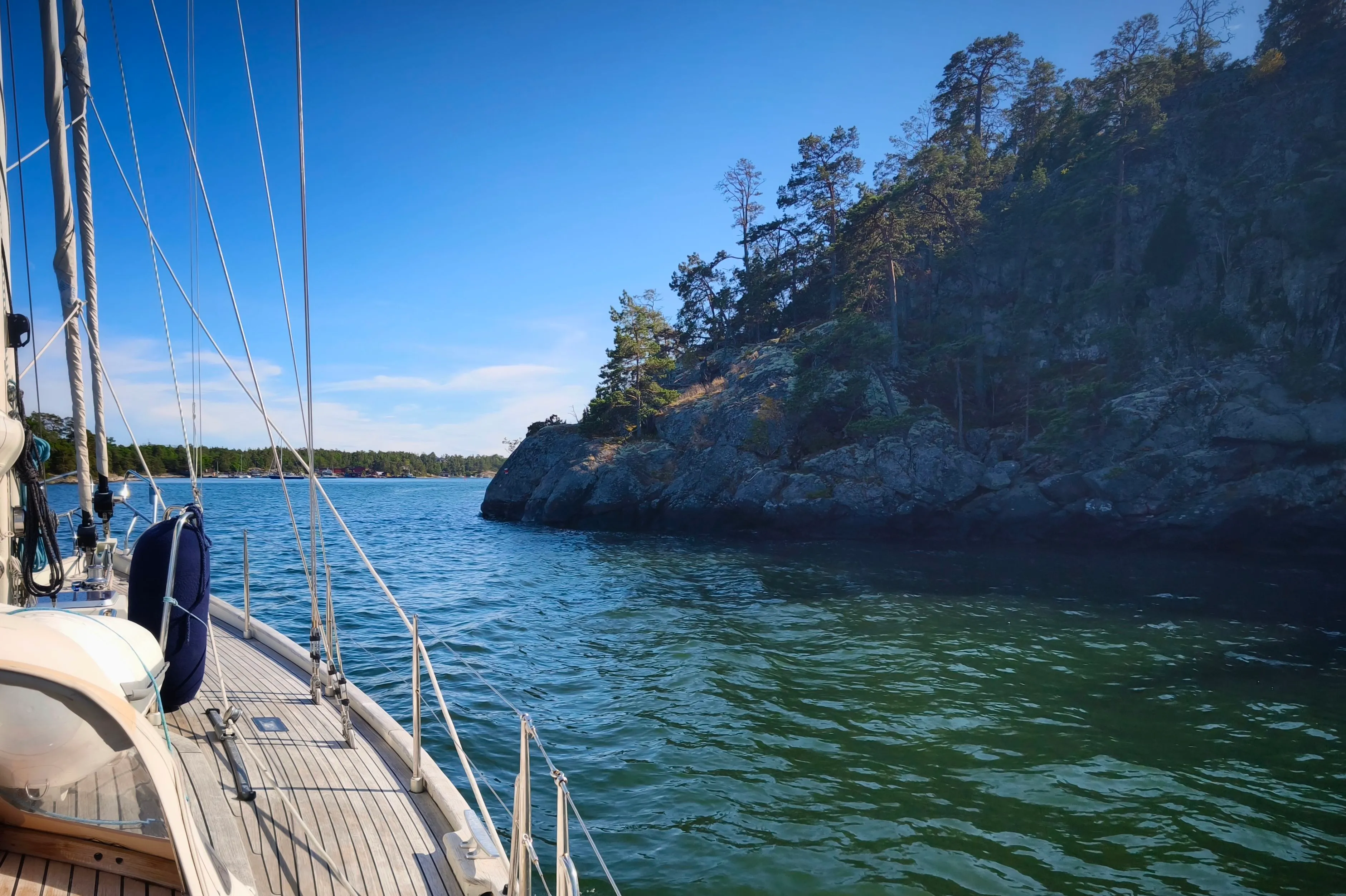
Narrow passage at Kymmendö.
The next morning was grey with drizzling rain and only the faintest breeze. I turned into a narrow bight a mile long in Uvön, surrounded by forest on all sides. This could have been one of Ptolemy’s mysterious islands at the northern edge of the world. But the anchorage at the end of the bight was already taken by a motorboat. The owner watched me from behind his glass veranda; he returned my wave with restraint, then watched from another window as I circled – and left.
I proceeded to Grönskär in Jungfrufjärden, a popular island nature reserve in Stockholm’s outer archipelago. On the plotter, I had observed several boats on AIS leaving the natural harbour and, as it was still early in the day, I hoped to secure a spot. Indeed, there was plenty of space to swing at anchor. I took a swim and then rowed the dinghy to land. In the pine forest, I discovered grazing sheep that seemed as surprised as I was. The sun set late and rose early, as in Tacitus’ description of the northern Baltic where the last rays of the sun blend with the first light.
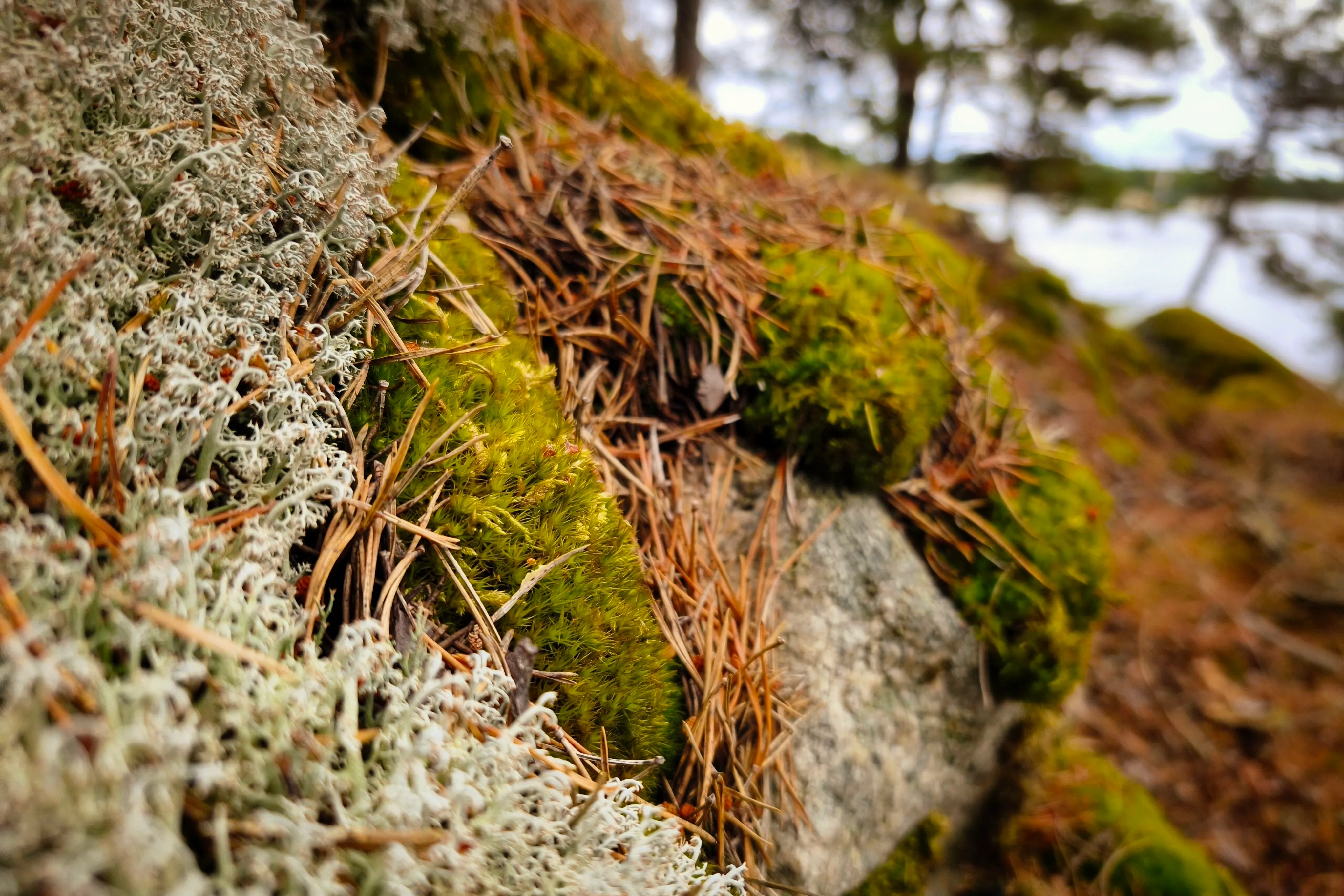
Lichen, moss, and pine needles on granite, Grönskär.
Dragging anchors
The neighbouring boat anchored upwind was slowly approaching over the following hours – the first case of a dragging anchor. The owner had realized it in time and was already looking for a safer spot. But in the meantime, a good number of boats had arrived and taken the sought-after spots bow-to at the round rocks. He finally found a rock that turned out to be the most protected spot the next morning when the wind had turned and picked up.
The wind had woken me at three in the morning. At anchor, I sleep lightly. After breakfast, I left Grönskärfladen for Styvnäset, a bight on the mainland. The forecast had called for a strong breeze and I needed a protected anchorage for the night.
Coelacanth accelerated and the maze of skerries and islands seemed to fly by, the channels closing in and opening out again. In the development section of Hugo Alfvén’s symphonic poem En Skärgårdssägen, a narrow intimidating minor second motif opens into a wider, heroic main theme of fourths in the horns – the intervals widen as the water does. Alfvén was passionately sailing the archipelago himself.
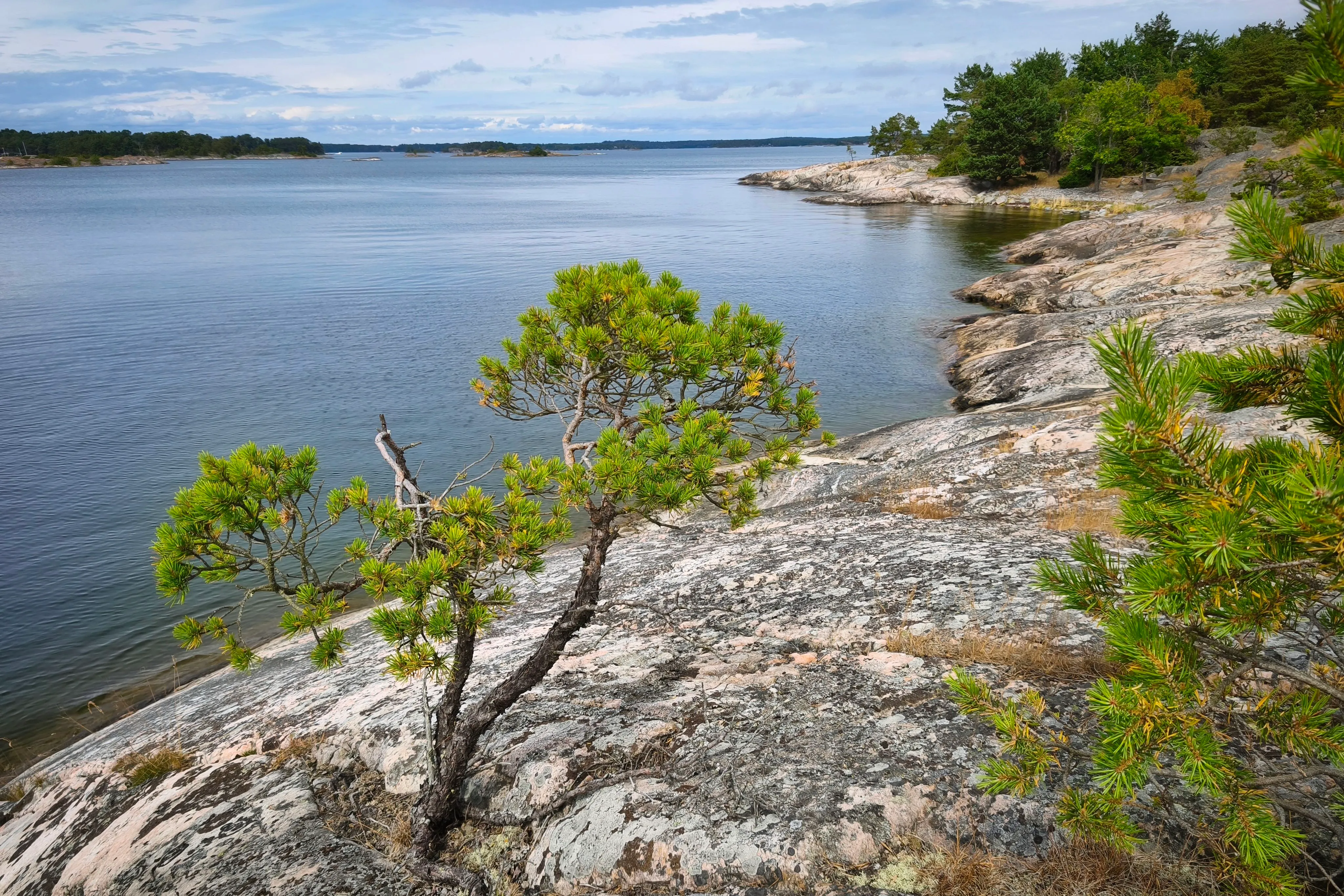
Stockholm’s outer archipelago seen from Grönskär.
After rounding the tip of an island, I passed a sailboat with its anchor down. I was surprised that someone would anchor that far out in the bay. There was nobody on deck; presumably the crew was still asleep. Then I realized that the stern of the boat was pointing into the wind! The anchor thus must have lost grip and was hanging free with the boat slowly drifting towards the cliffs at the end of the bay. Dragging anchor number two. Before I could take action and maybe blow the fog horn, the crew must have woken up – perhaps the anchor chain rattled as it hit a submerged rock – and motored back into the bay.
Before noon I arrived in the bight of Styvnäset, which was empty of boats. The closer to Stockholm one gets, the more boats are underway and the more difficult it gets to find a sheltered place for the night. Relieved, I dropped anchor. Soon the gusty wind increased to the promised 11 m/s. Scandinavian weather services give wind speed in metres per second; doubling it approximates knots – more familiar to me. Although surrounded by rocks with forest on both sides, the end of the bight featured lower trees – exactly where the wind came from. Half a dozen boats entered the bight over the following hours. Most turned around immediately; one set anchor but gave up after two hours and left due to poor holding – the third case of a dragging anchor.
At the peak of the gusts, my anchor alarm went off. Coelacanth’s amply sized Rocna Vulcan had very slowly moved a few metres, too, the last in a series of dragging anchors. I reset it a bit upwind, and the evening and night remained quiet.
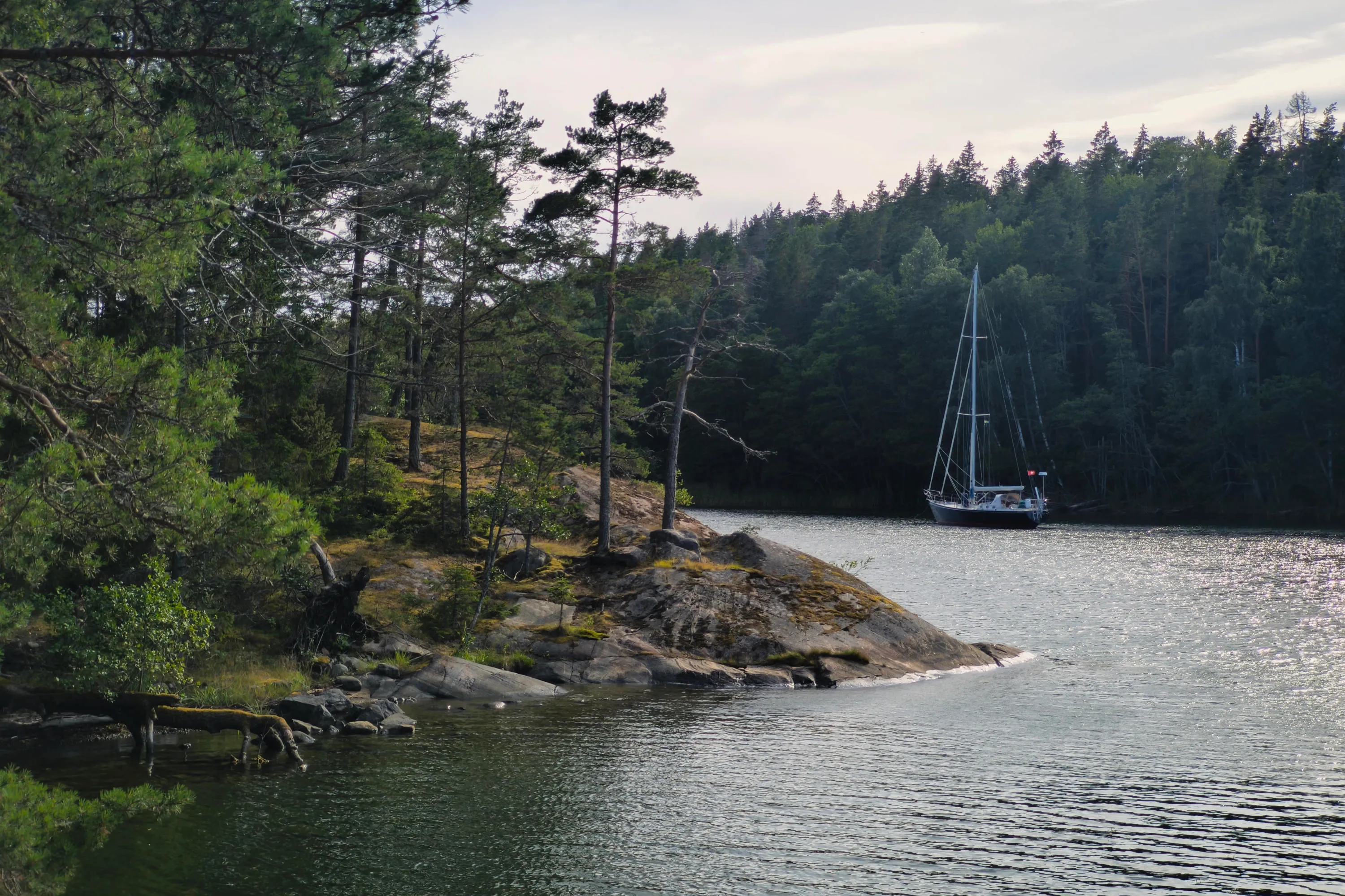
Coelacanth anchored in Styvnäset.
A recovery from the freedom of sailing
A falling barometer and the forecast of another near-gale came together. A stay in a marina fitted my plans, and the need for laundry and provisioning. My finger joints ached from working the sheets and anchor chain and my core muscles were tired from constantly maintaining balance. I was not yet used to the daily physical work that living on a sailboat demands.
Gustavsberg is reached via a narrow fairway, and the marina has all one needs after days of anchoring. As usual in Scandinavia, the pontoons have rings that require stepping off the boat, but a hamnvärd was already waiting to take my line and help a tired sailor moor. It was on the way to the marina that the log showed 1000 miles since leaving the Netherlands.
All roads lead to Rome, but only three to Stockholm
There are three principal routes into Stockholm: Lake Mälaren, the inner skärgård around Vaxholm, and the historic Baggensstäket route – the most interesting and scenic one.
In the Middle Ages, Baggensstäket was the main waterway to Stockholm, until postglacial land uplift made the channel shallow. In 1719, a detachment of the Russian fleet attempted to enter Stockholm via this backdoor – bypassing Vaxholm castle – but the Swedish troops obstructed the narrowest and shallowest part, rendering it non-navigable, and beat them back.
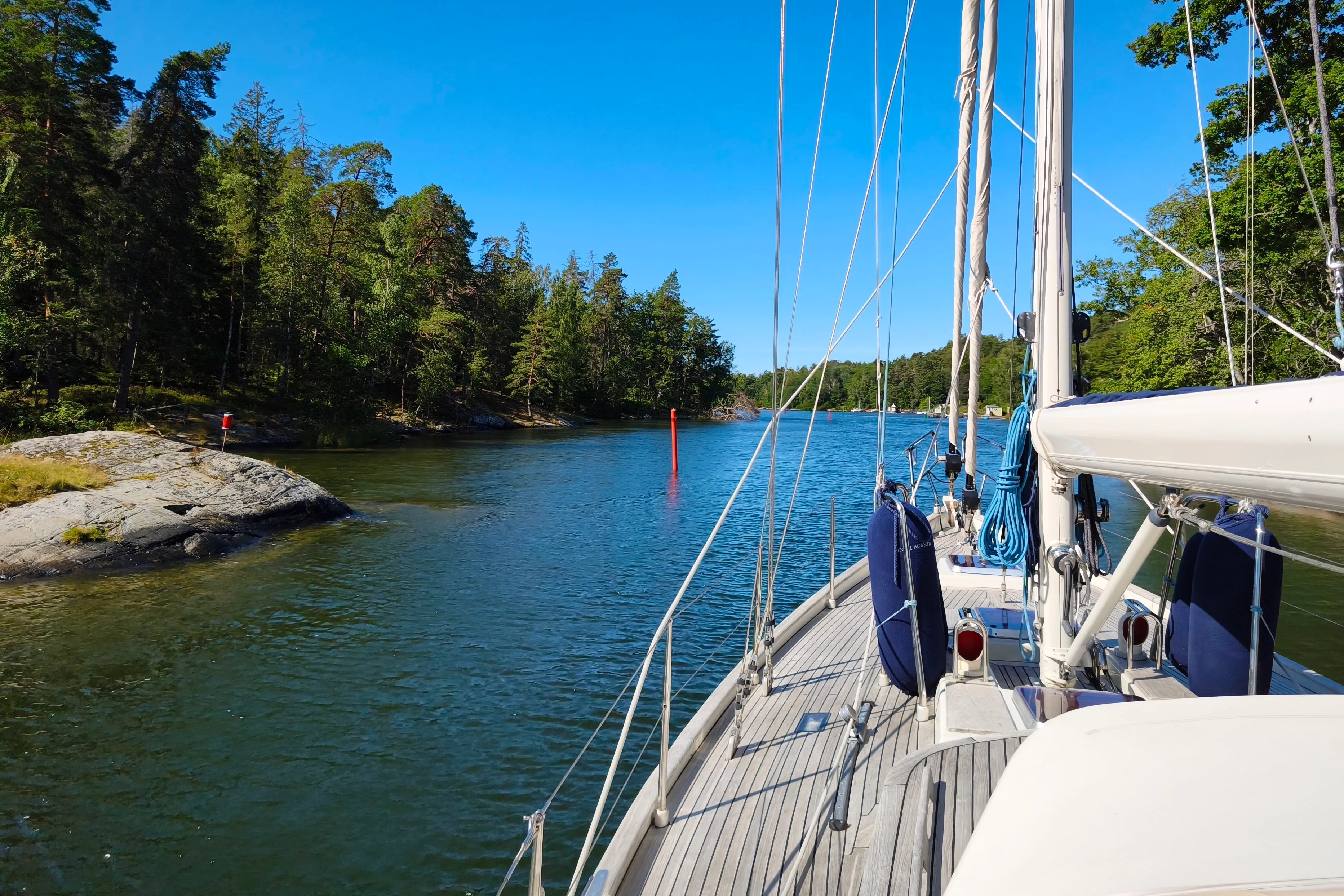
A narrow and shallow section of the Baggensstäket.
Today’s minimal depth is around three metres, more than enough for Coelacanth’s draft. I was lucky to meet one of the ferries in a wider section, as the narrow parts would hardly allow two boat to pass each other. Then came the busy fairway into the centre with numerous ferries, sightseeing boats, jetskis, sailing yachts and motorboats. With one eye always on the surrounding water, I prepared fenders and lines for mooring.
Stockholm’s Wasahamnen is located on the seaward side of Djurgården and gets a fair amount of swell from the passing ferries even though its entry is narrow. I put Coelacanth in reverse, although as a full-keeler she doesn’t go straight backwards. Mooring single-handedly is easier when the stern gets to the pontoon first – especially if there are rings and not cleats to attach the lines.
The skipper of the neighbouring boat commented on the ship’s name. Apparently, of all people, I had moored next to an evolutionary biologist! He told me that there is a coelacanth in the Naturhistoriska riksmuseet.
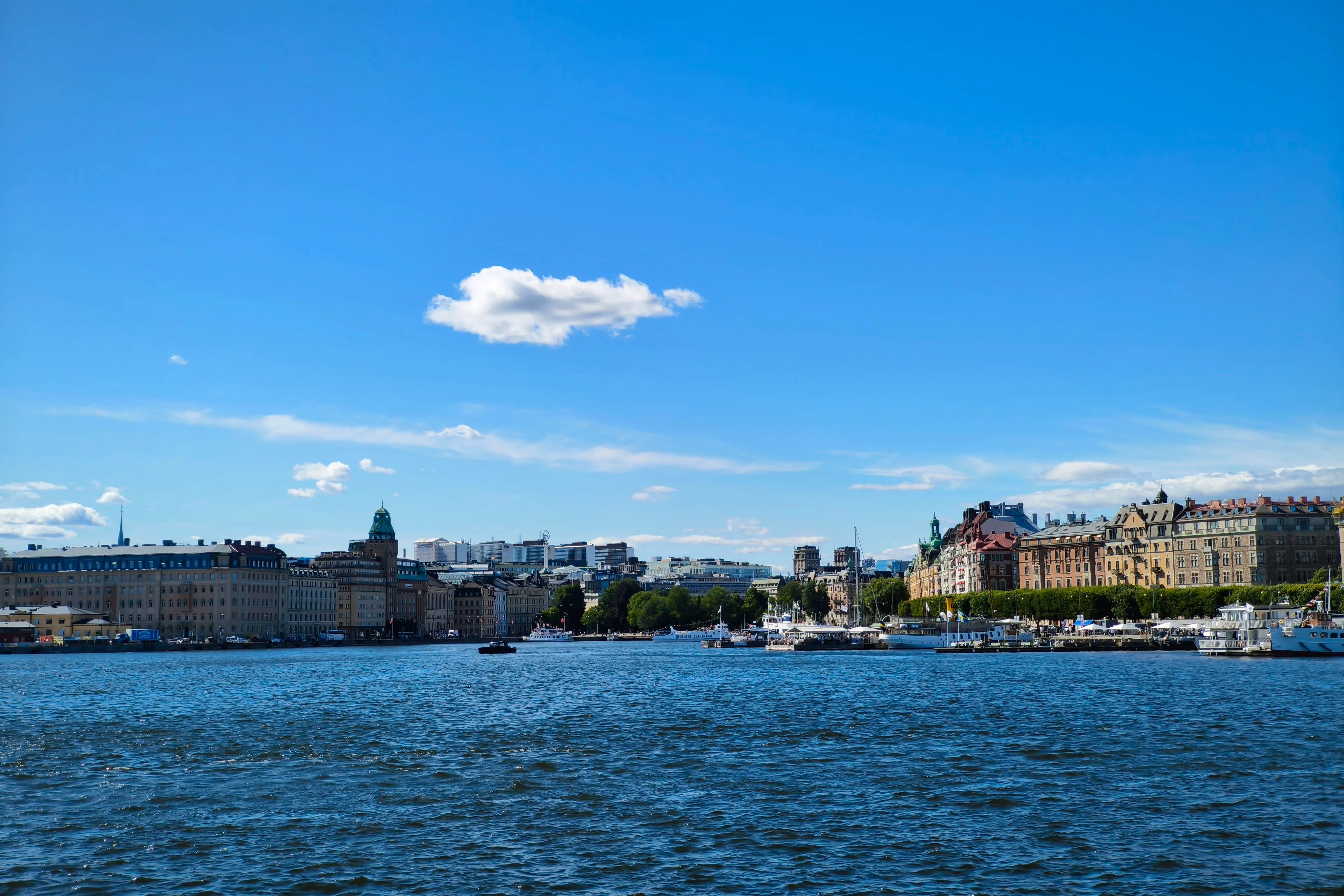
Stockholm.
Contrasts in the city
After the anchor nights far out in the archipelago, the city bustle was a stark contrast. In Kartbutiken I bought the chart for the next leg and returned to Coelacanth.
There’s an amusement park nearby and people apparently enjoy falling from the dizzying heights of a tower while screaming at the top of their lungs. Gröna Lund has a long history of amusement; Carl Michael Bellman’s 1790 song collection describes a brawl in a Gröna Lund tavern after heavy drinking (Fredman’s Epistles No. 12). But the Epistles also capture the contrasting beauty of nature scenes (No. 39, “Storm och böljor tystna ren”):
The storm and waves already fall silent,
the dim light of the vault of heaven
grows weaker and weaker,
already it begins to dawn,
the clouds swim,
close air and mist
herald the sun’s pale streak.
I was longing for swift sailing on open water, an empty horizon, flying spray, and a fair wind from any direction but the east.