Southwesterlies and crumble cake
Waiting for fair winds is part of sailing. But not every sailor is equally patient. Agamemnon sacrificed his daughter Iphigenia to gain favourable winds for the Greeks. Once the sacrifice was made, the winds returned and the fleet sailed for Troy.1
After arriving in Kiel from Sweden, the season had changed to autumn; serial lows with plenty of rain and thunder passed. Two friendlier days were used to motor through the Kiel canal to Brunsbüttel, and then to sail to Cuxhaven on the river Elbe, pushed by the tidal stream. Once again, the wind blew from the west and there was plenty of time to study the weather, consider a sacrifice, and bake crumble cake2 instead of suffering.
In Aeschylus’ Agamemnon, wisdom comes through suffering.3 But had Agamemnon had more patience and faith, a lot of blood would have been spared in the Trojan War. On a sailboat, suffering often leads to destruction. Or in sailors’ terms: only idiots and racers sail upwind. The Finnish Kalevala has no bribing of the gods.4 So there is only the patient, meteorological way of knowing when to sail on.
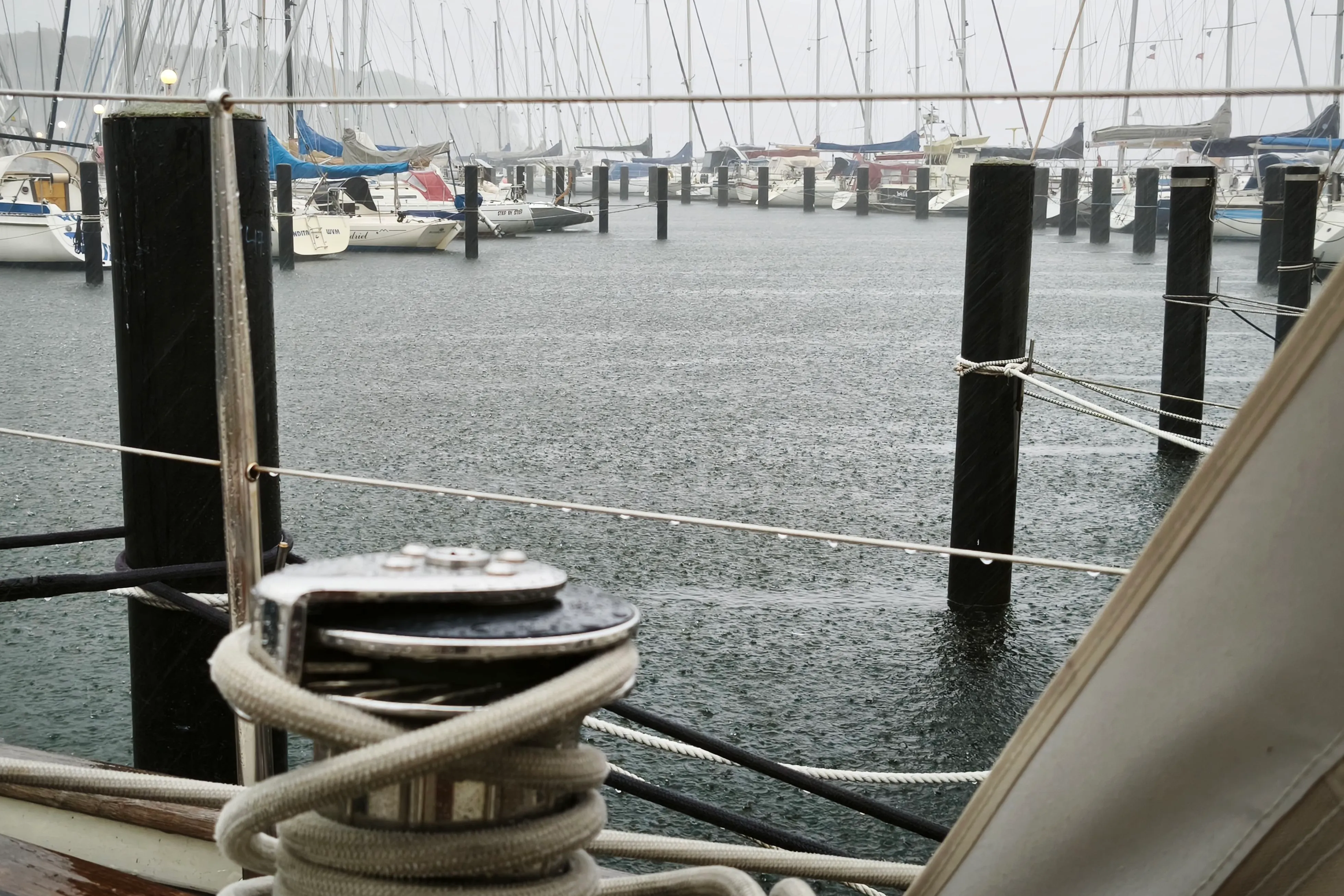
Thunder and rain in Kiel.
Forecasting the wind
In the North Sea, the prevailing weather pattern consists of lows passing from the North Atlantic over the British Isles, creating southwesterly winds.5 Easterly winds on the German and Dutch coasts of the North Sea occur when A) a high-pressure system over Scandinavia deflects the approaching Atlantic low-pressure systems to the north, or B) a relatively short-lived (12-30 hours) high-pressure ridge over northern Germany builds between two lows.
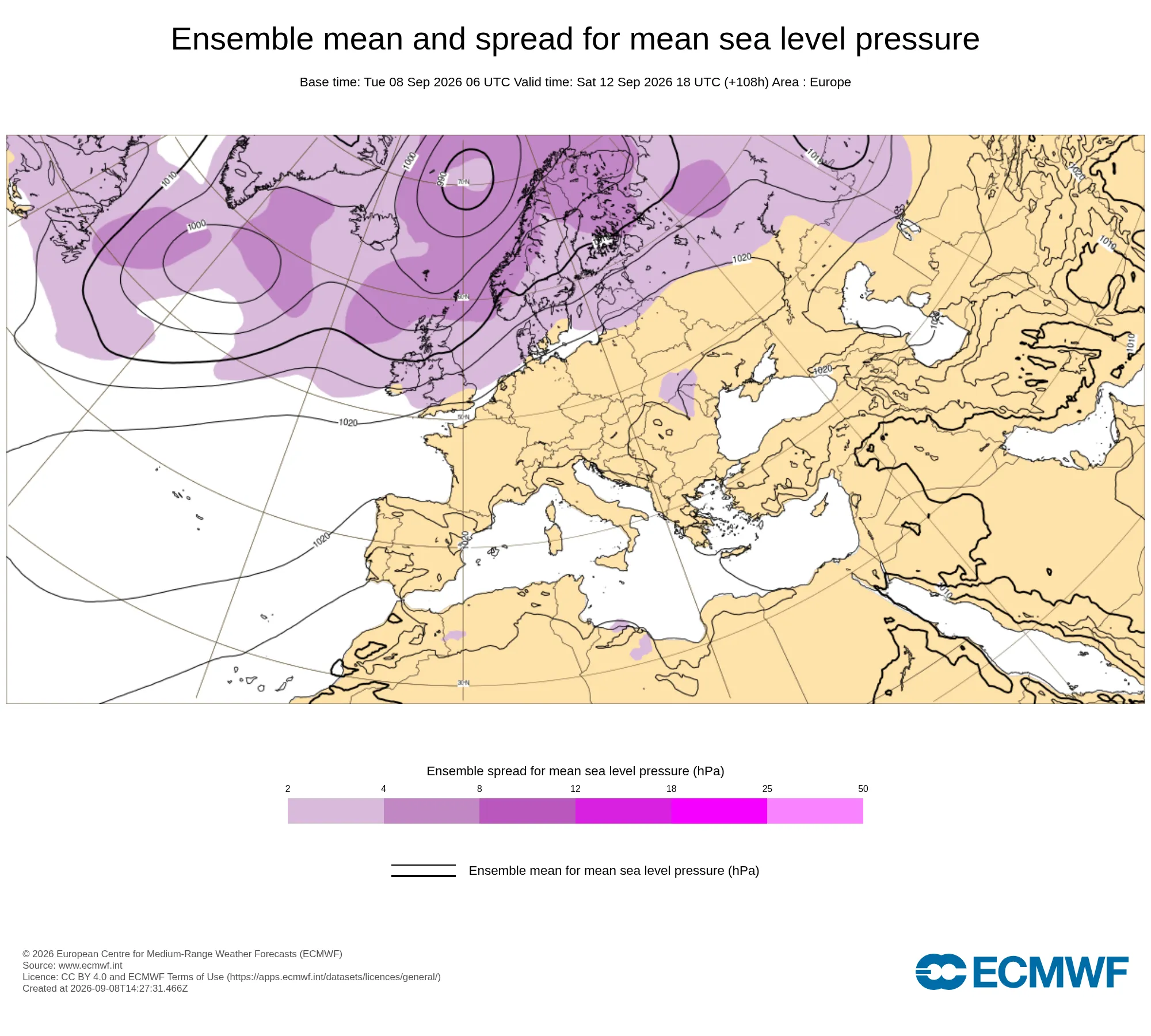
ECMWF forecast, 8 September 2026: a short-lived high-pressure ridge is extending from the Azores to western Russia (forecast for 12 September). The forecast turned out well; the ensemble spread (pink) was still significant.
Passage planning
While the Baltic Sea allows one to wake up and then decide where to sail, the North Sea makes planning a passage such as Cuxhaven to the Netherlands much more complex.
The Tides: Sailing westwards is not as advantageous as sailing eastwards, because the tidal wave runs eastwards along the Frisian coast. The favourable tidal stream lasts only 5½ hours; eastbound the same cycle gives just over 7. On top of that the coastal residual sets east at 0.2–0.4 knots all day. For a passage that goes over four tides, the first would use the strong ebbing stream leaving the Elbe from Cuxhaven, and the last would be on the flood entering the Wadden Sea (high water Lauwersoog 11 September 2026 at 11:23).
The Weather: The two-week ECMWF model did not forecast any easterlies. But two days after a low had passed over the North Sea, a high-pressure ridge extended from the Azores to western Russia; this would make the westerly wind back to south in the evening, according to the high-resolution ICON model. Not as ideal as a stable high-pressure system over Scandinavia providing easterlies for longer periods, but the next best. In the early afternoon of the second day, the wind would already veer west, caused by an occluded front belonging to a low over Iceland, and make continuing to Terschelling unrealistic. In summary, there was a 14-hour window of southerly wind from 10 September 22:00 to 11 September 2026 12:00.
| Position | Log (nm) | Time | Wind (Bft) | Tide | Course |
|---|---|---|---|---|---|
| Cuxhaven | 0 | 13:00 | WNW 3-4 | fair after 1.5 h | NW, then WNW |
| Elbe 1 | 20 | 16:30 | WSW 0-2 | fair | 250° |
| Norderney | 58 | 24:00 | S 4-5 | foul | ” |
| Borkum | 86 | 06:00 | S 4-5 | fair | ” |
| Westgat | 102 | 09:00 | SSW 4-5, rain | fair | S, then SE |
| Lauwersoog | 114 | 12:00 | SSW 4-5, rain | High water 11:23 |
The actual sailing
Having a plan is good, sticking to it even better. That’s why my passage plan and the actual sailing match closely. It was clear that sailing westwards would be a compromise: the short window of southerly wind wasn’t ideal. The engine would have to be used for the first leg against the westerly wind.
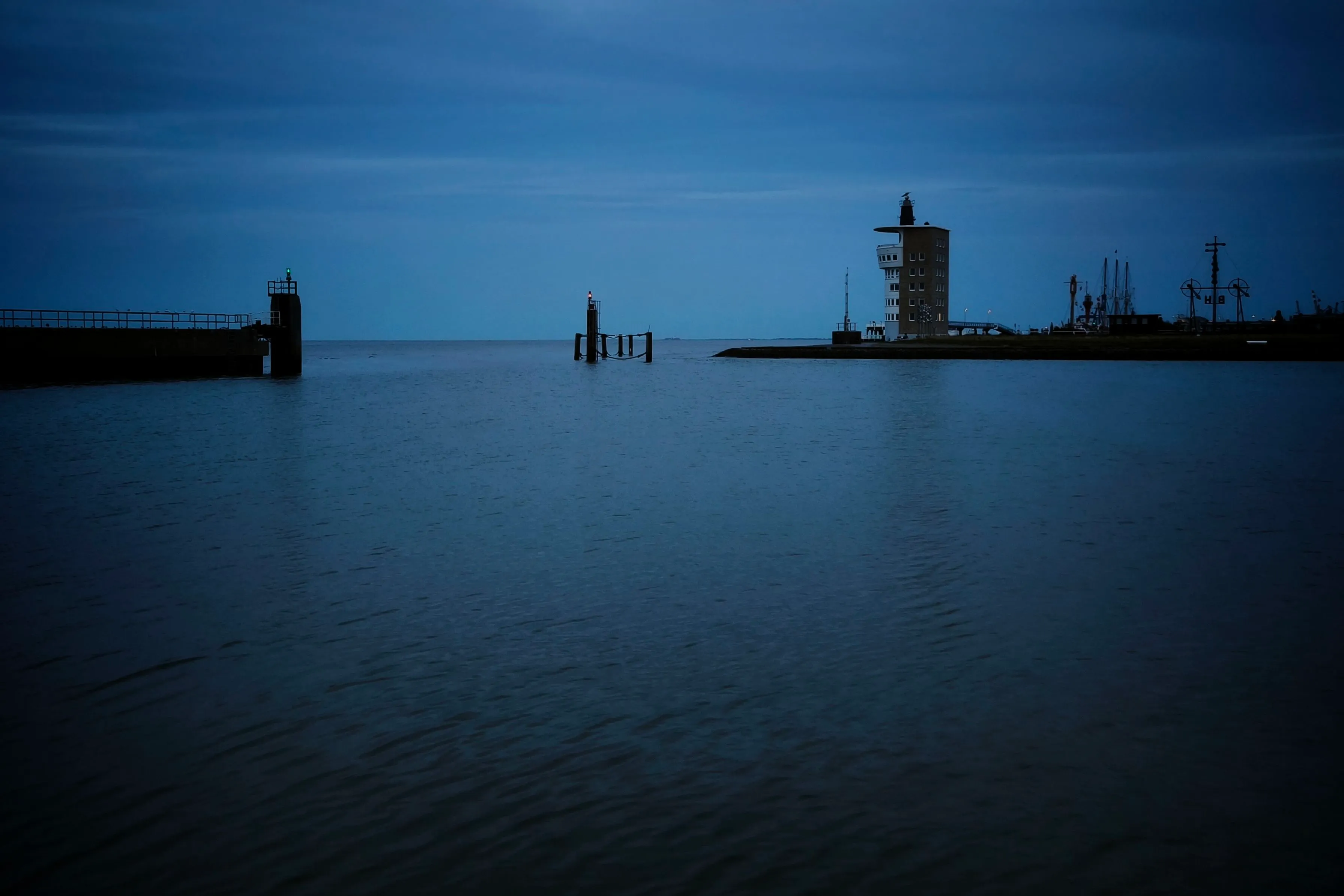
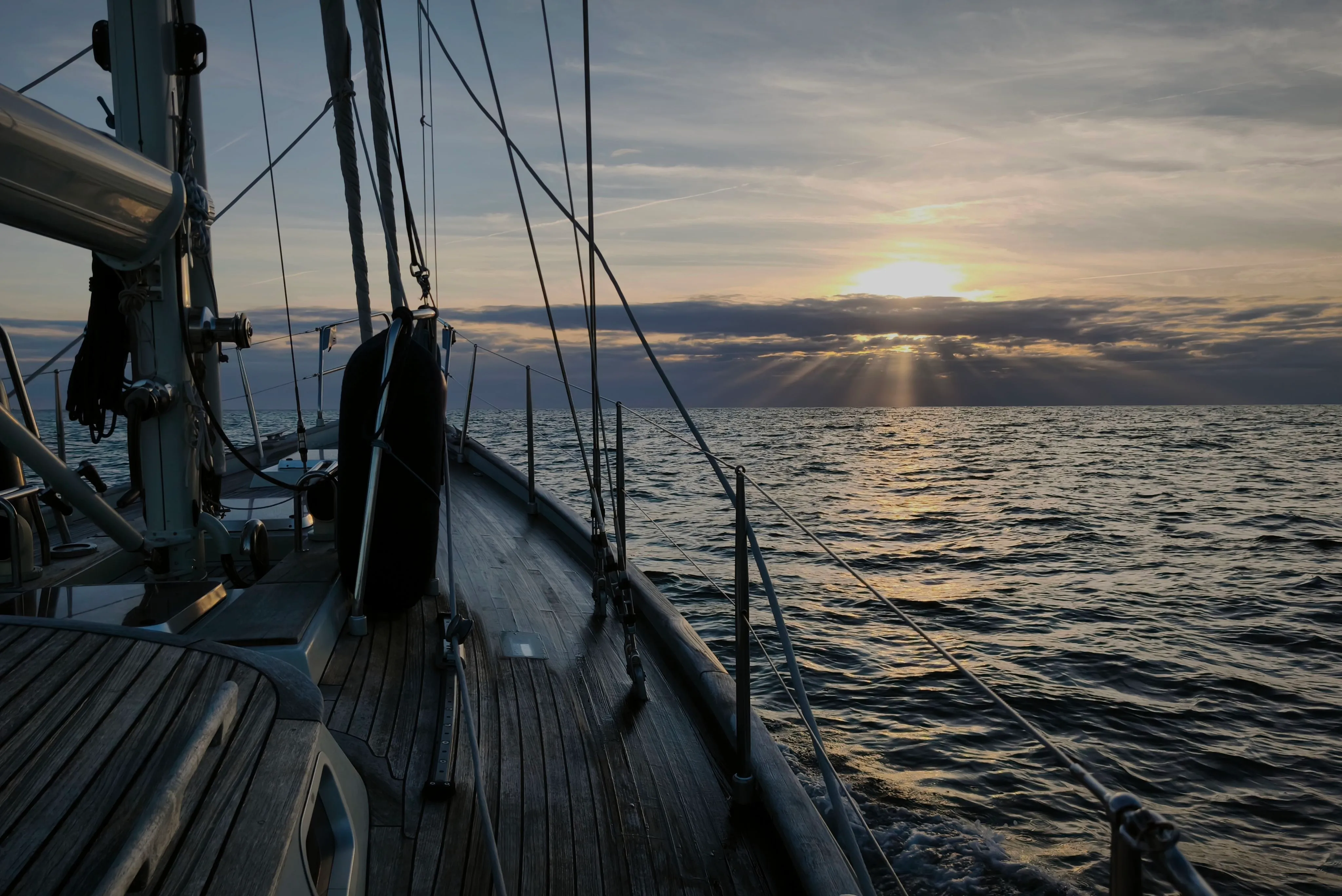
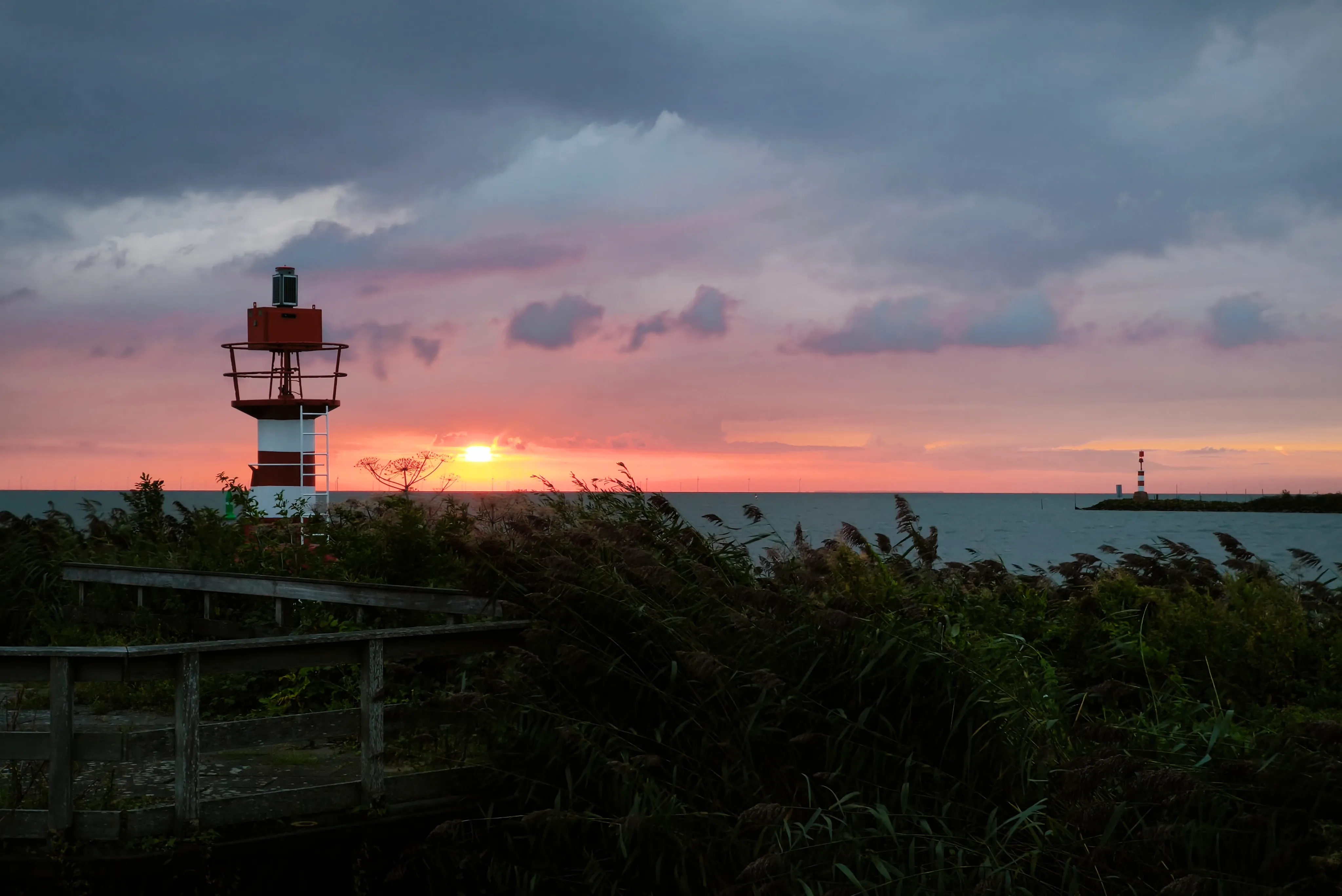
We motored out of Cuxhaven, carried by the Elbe’s ebbing stream. At ten in the evening, the wind backed to south, as predicted. Finally, the engine could be turned off. Coelacanth raced under full sail through the night, along the lighthouses on the Frisian islands. But then, the jib’s halyard shackle at the head of the sail broke off. We had to roll in the sail and continue only on the smaller staysail. Nevertheless, we passed Norderney in time according to the plan.
Then the wind veered to south-southwest. At the same time, we had to adjust course slightly after Borkum, heading 15° further south. In consequence, speed dropped dramatically. Neither alone would have done it; together they took the true wind angle from 78° to 40°. We had anticipated that, and Lauwersoog had been chosen as the destination instead of Terschelling. But we had hoped to be able to sail that leg. Instead, the engine went back on at Riffgat. At that true wind angle the boat could not drive through the sea fast enough to catch the flood. We arrived in Lauwersoog after 116 nm or 22 hours.
Later on the journey, my son Sebastian went up the mast in a bosun’s chair to replace the lost head shackle of the jib furler swivel.
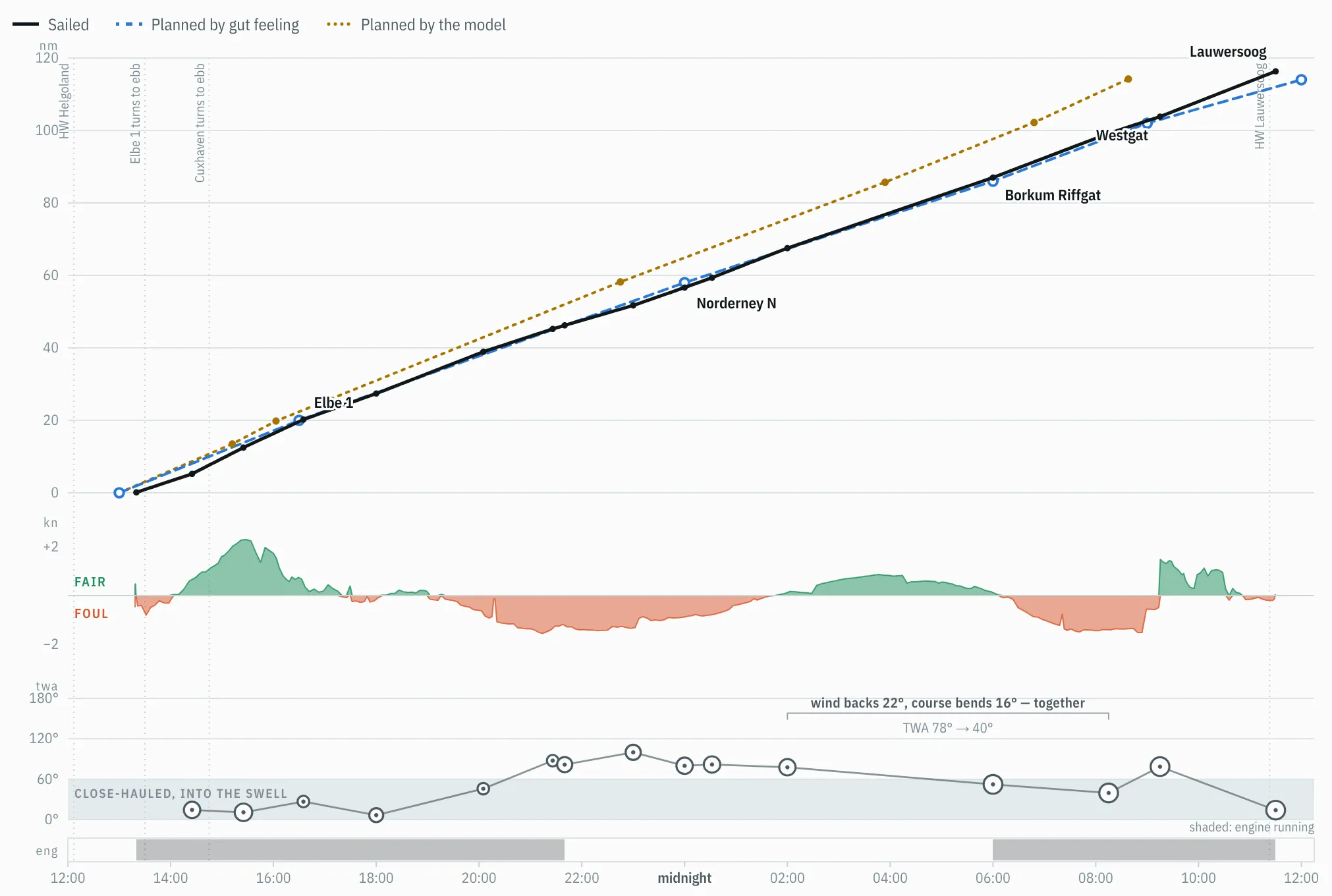
Two passage plans and the actual sailing. The plan by the tide model was adapted by “gut feeling”. It correlated well with the actual outcome. The wind shift to south-southwest and the necessary course change after Borkum to south acted together to make the true wind angle too small to sail against wind and waves. That’s why the resulting engine hours at the end of the journey were much higher than wished.
Equality on land and water
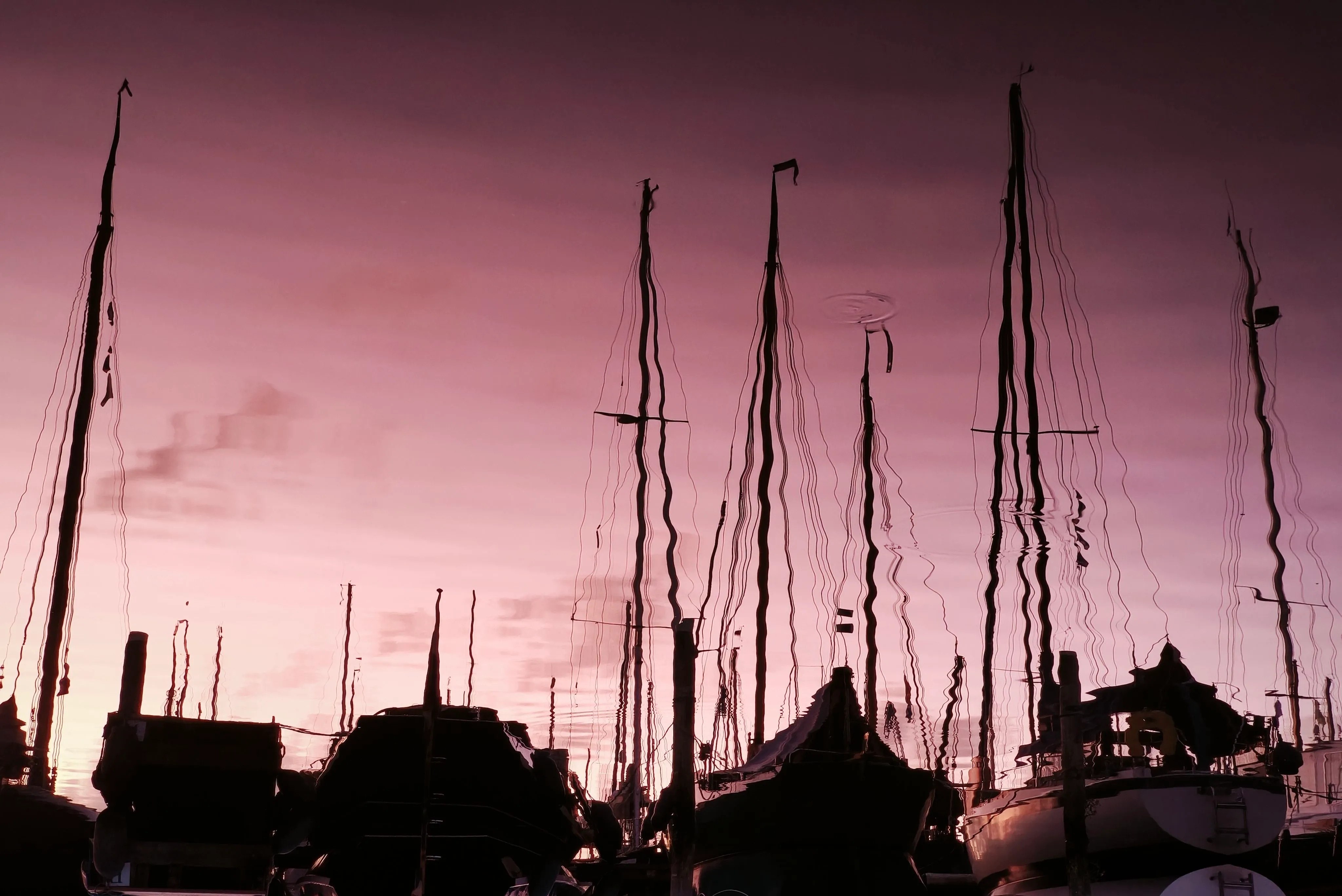
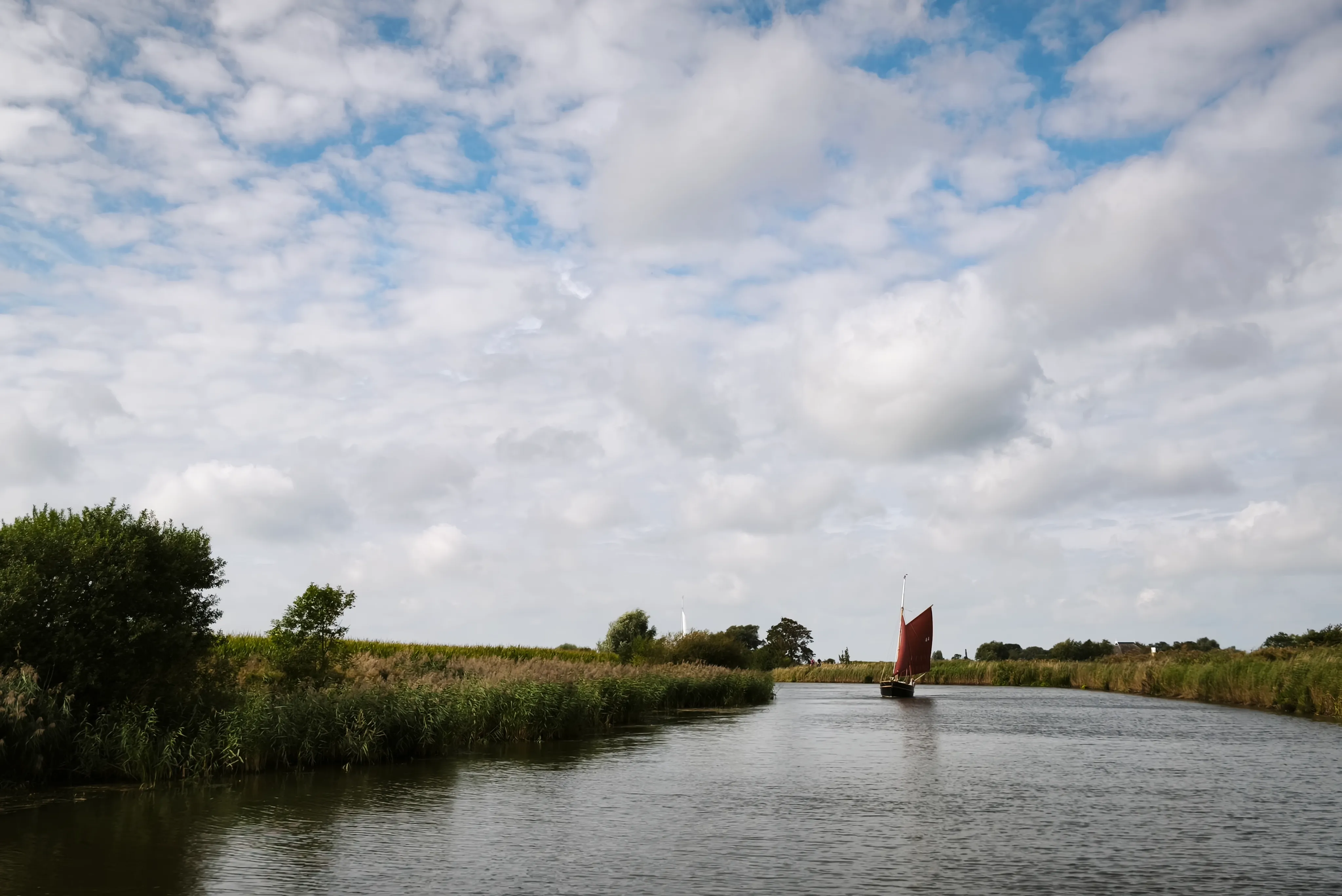
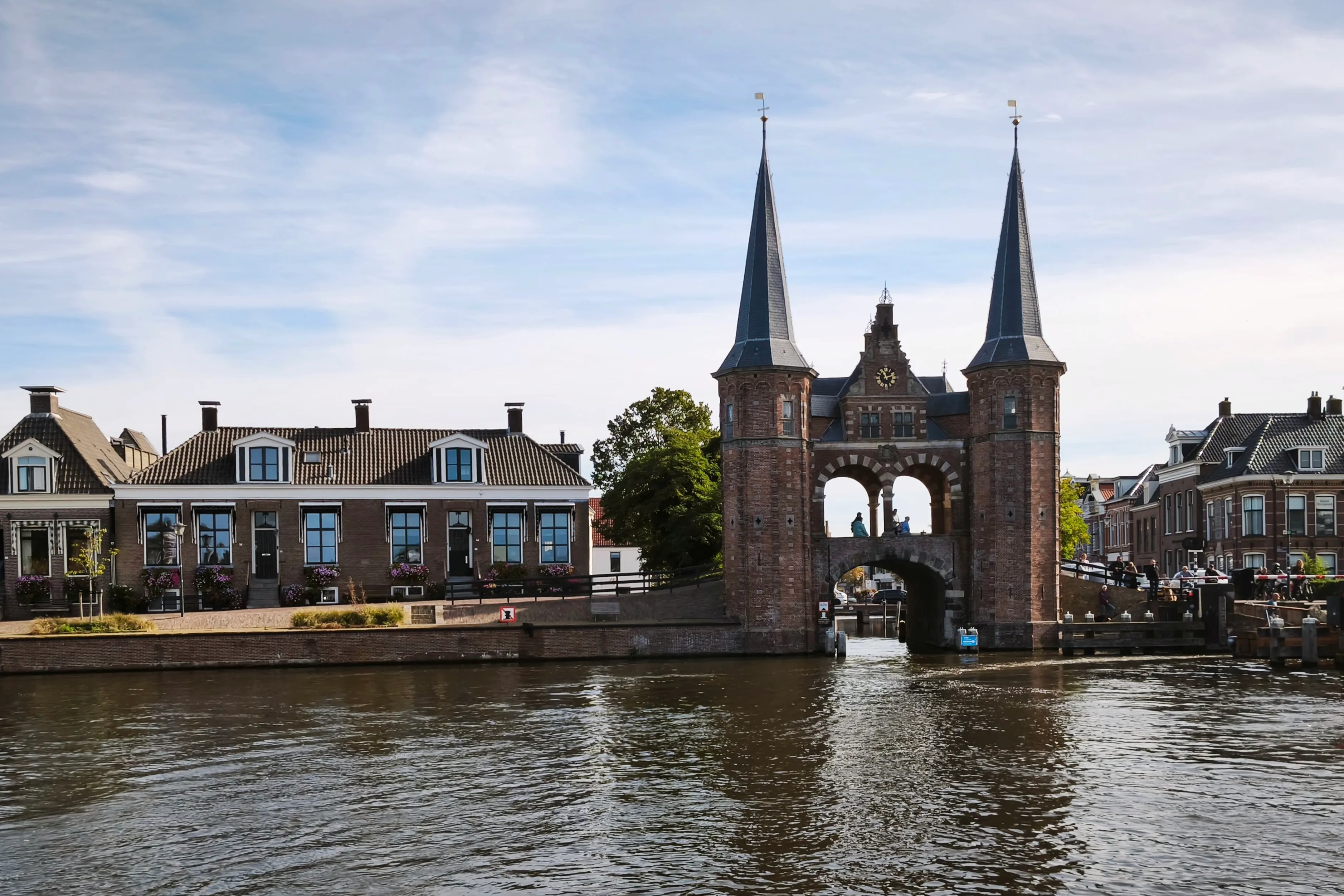
Instead of motoring on against wind and tide, we continued inland through the Staande Mast Route via Lauwersmeer, Dokkum, Leeuwarden, and Sneek into the IJsselmeer. These canals have served Dutch skippers for centuries.
A sailboat’s mast and a bridge have collision potential. But not on the route through these canals. Every bridge opens magically without waiting more than a few minutes. A friendly bridgemaster waves out of his window, and on goes the journey through the Frisian pasture. Most impressive are the railway bridges: even for a single sailboat, they swing open between two trains racing by.
Everyone has equal rights in Dutch traffic: the car, the bicycle, the train, and the boat.
Merging electronics and paper
Unfortunately, Raymarine Axiom plotters do not export the GPS tracks with timestamps.6 My paper logbook had timed fixes but no continuous position. I joined the two: each fix was matched to its nearest trackpoint, and the times were spread along the distance between fixes. This gave a track where every one of 368 points carries a time, and therefore a speed.
Adding the tidal data from BSH7 and wind data gave a tidal stream and a wind angle. The BSH model accounts for 88% of the variance in a three-knot speed swing on unchanged revs. This is the cleanest result of the passage: a stream forecast, taken two days ahead, explaining almost all of an enormous variation in progress.
What the plan missed: adverse factors compound. It contained both numbers, the wind shift and the course change after Borkum, but never combined them. Had it done so, it would have shown that we would be motoring again from Riffgat.
Tinker and maintenance
The GPS track analysis made it clear that this is the point where a Raspberry Pi accessing the NMEA2000 (SeaTalkNG) network is useful to log all data underway. Currently, my Raspberry Pi Zero 2W is working as a self-constructed Navtex receiver: project Ilma.8
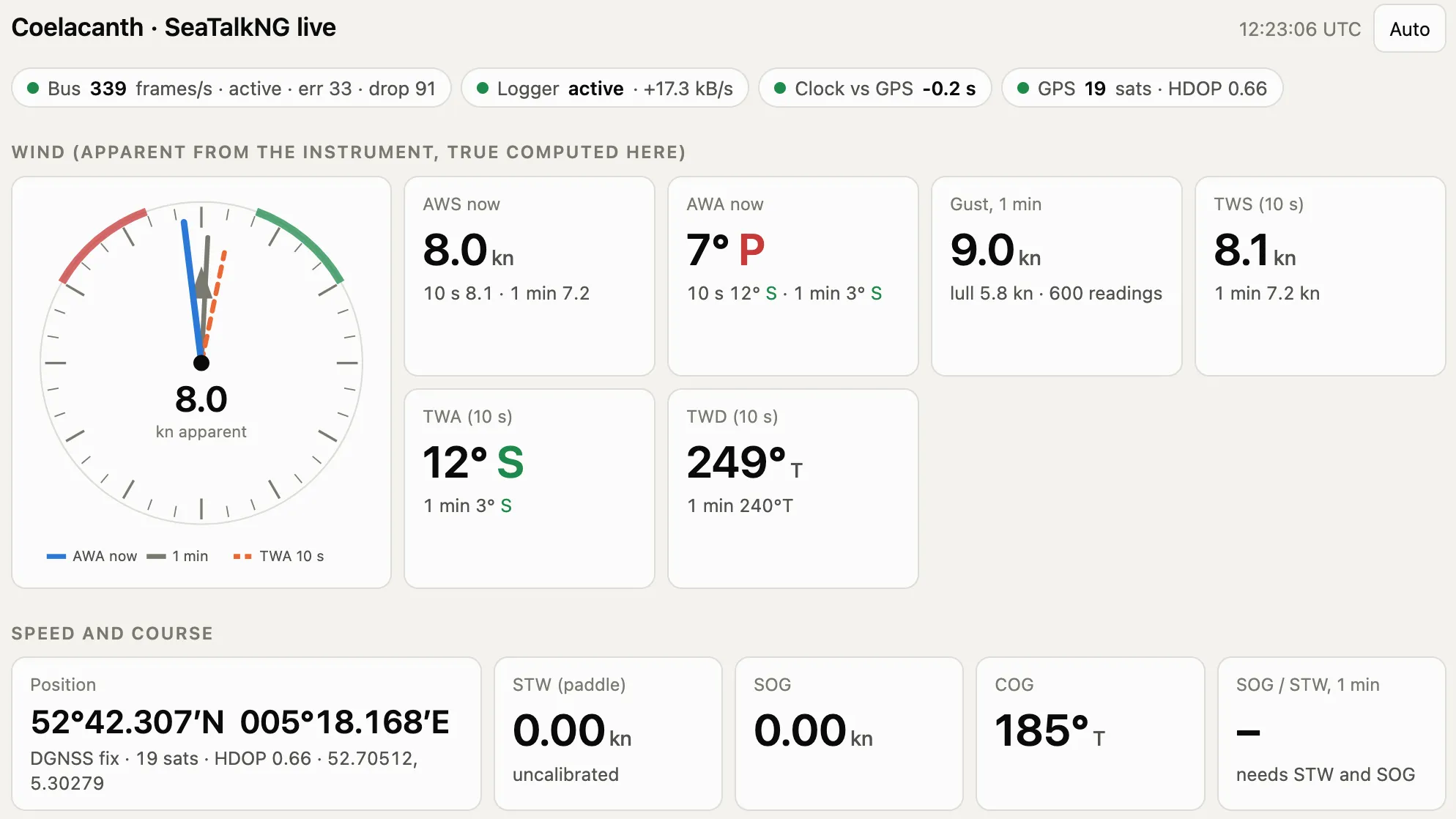
The Raspberry Pi read-out of the NMEA2000 data provided by Raymarine instruments.
I bought a SeaTalkNG T-piece and cable, connected it to a CAN-HAT on the Pi – and there’s all the NMEA2000 data coming in! I can log GPS, wind, course, speed through water, etc., all together with time. To complete this step, engine data is also routed into the network to log miles under engine.
When I installed the cabling from the alternator’s RPM-counter, I must have partly disconnected the engine’s control panel. The engine wouldn’t stop on pressing the button, and I had to close the fuel line. I was surprised how long the engine kept running – patience was needed.
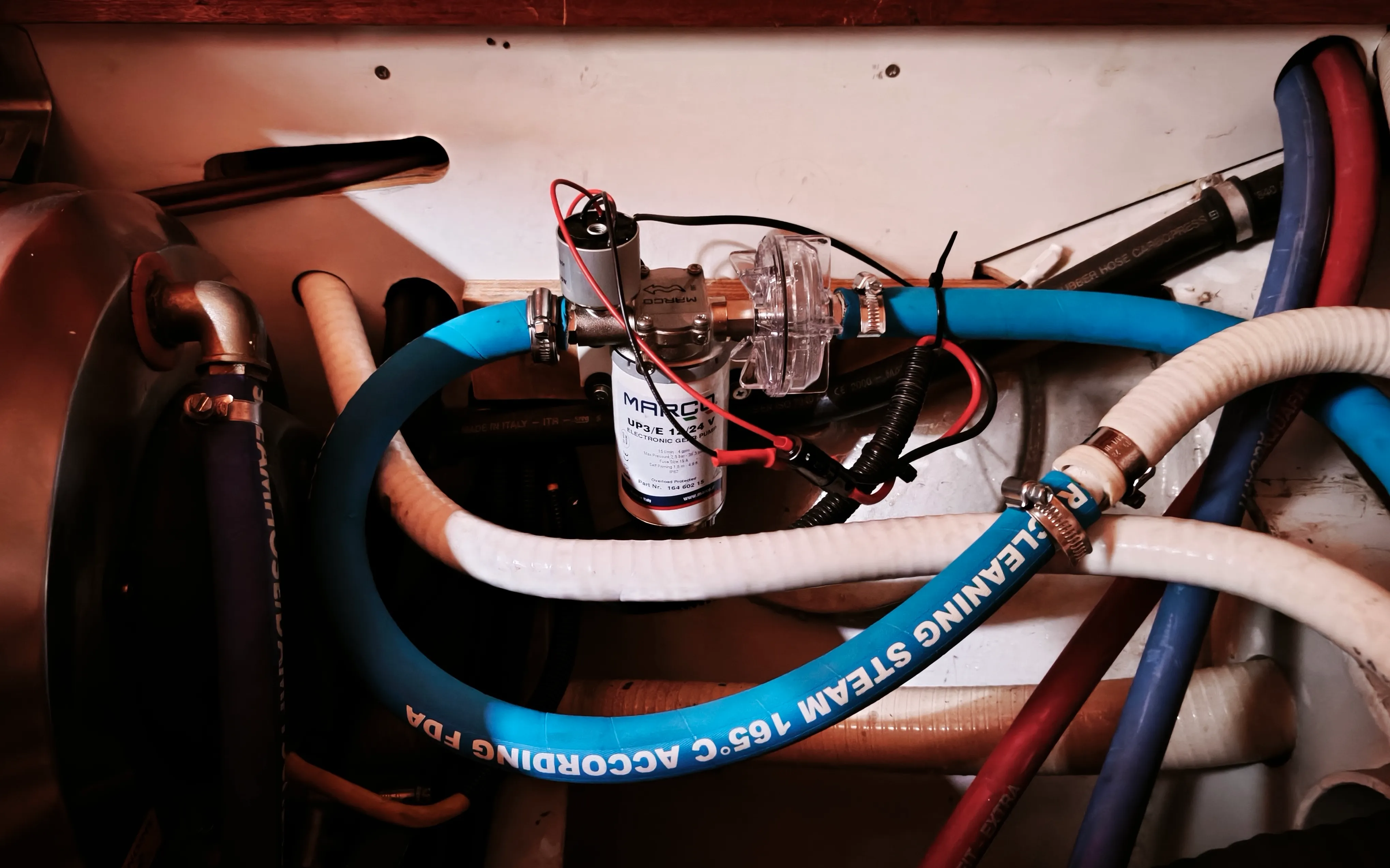
The new Marco UP3/E freshwater pump installed after removal of the old pump and also the accumulator tank.
Being only a few steps away from the ship chandlery in Enkhuizen, I also installed a new freshwater pump. The old Flojet had weakened over the last weeks and finally given up. I bought a Marco UP3/E, removed the old pump and the accumulator tank, then installed the new pump on rubber feet and put a 15 A fuse in. The water connectors needed adapters for their different diameters. And a piece of water hose. And hose clamps. I only had to go back to the chandlery three times.
By the way, since the Ystad – Kiel leg three weeks ago, there has not been a single day of easterlies. Waiting in Cuxhaven would have meant baking and eating a lot of crumble cake.
That closes the journey from the Netherlands to Finland via Germany, Denmark, and Sweden. Overall: 2,100 nautical miles sailed.
Footnotes
-
There are different versions of Iphigenia’s fate. In Aeschylus’s Agamemnon and most tragic tradition, she is killed outright, and this act becomes the deed for which Clytemnestra later murders Agamemnon in revenge. In Euripides’s Iphigenia at Aulis, she goes to her death willingly, embracing it as glory for Greece. In Euripides’s Iphigenia in Tauris, Artemis substitutes a deer at the last moment and spirits Iphigenia away to Tauris to serve as her priestess, sparing her life. ↩
-
Knead a dough of 500 g wheat flour (type 550) and yeast, an egg, 80 g of sugar, 220 ml milk, half a teaspoon of salt, vanilla, and 100 g butter. Let it sit for some time on a baking sheet, then spread jam on it. For the crumbles, mix 280 g wheat flour, 140 g sugar, 140 g butter, and a pinch of salt. On my mother’s recommendation, I heat the crumbles in the frying pan for a few minutes to make them more crispy. Then cover the dough and the jam with the crumbles and bake the cake in the oven (in my boat’s gas oven about 45 minutes at 200°C). ↩
-
Páthei máthos, in Richmond Lattimore’s translation (1953): “wisdom comes alone through suffering.” ↩
-
Ukko is more distant, less interventionist than Zeus, and he is no Aeolus, who manages every wind. ↩
-
The printed pilot chart giving the prevailing winds for a given month is available online at https://pilot-chart.com. ↩
-
I asked Raymarine support, and they confirmed that exported gpx files do not carry timestamps. ↩
-
Bundesamt für Seeschifffahrt und Hydrographie, tidal data available for download. ↩
-
Details about my project Ilma can be found here with a recent update on improvements, and the project website. ↩